The EAA is a scoped directive, not a blanket web law
The European Accessibility Act is Directive (EU) 2019/882 of 17 April 2019 on the accessibility requirements for products and services. It applies to a defined list of covered products and services, rather than to every website you run. Member States had to transpose it by 28 June 2022, and the measures apply from 28 June 2025.
Because it's a directive, the binding rules live in your country's national law, not in the EU text itself. A directive sets a result each Member State must reach, while leaving the form and methods to national authorities. So check the national transposition where you operate; the wording and enforcement details differ.
Scope is a specific list. Article 2 names the products and services covered: computer hardware and operating systems, self-service terminals, e-readers, electronic communications, access to audiovisual media services, elements of passenger transport, consumer banking, e-books and dedicated software, and e-commerce. The European Commission lists the same set. If your audio or video sits inside one of those services, the media rules below apply.
European Accessibility Act transcript requirements in the directive's Annex I
The media obligations live in Annex I. For access to audiovisual media services, Annex I requires the access services to be fully transmitted with adequate quality and synchronised with sound and video. Those access services are subtitles for the deaf and hard of hearing, audio description, spoken subtitles, and sign language interpretation, with user control over their display.
Read the scope precisely. The in-scope service is services providing access to audiovisual media services, and the EAA defines audiovisual media services by reference to Directive 2010/13/EU. In practice, that's the access layer around broadcast and on-demand video, plus the consumer equipment that plays it.
E-books carry their own line. Article 2(2)(e) covers e-books and dedicated software, and Annex I adds that when an e-book contains audio in addition to text, it must provide synchronised text and audio. If you publish an audio-plus-text e-book in the EU market, that synchronisation is a requirement you have to meet.
How do you make audio and video content EAA-compliant?
Match the media type to the right artifact. WCAG 2.1 sets three success criteria that decide this: audio-only prerecorded content needs a text alternative under SC 1.2.1 (Level A); synchronised media needs captions under SC 1.2.2 (Level A); and prerecorded video needs audio description under SC 1.2.5 (Level AA).
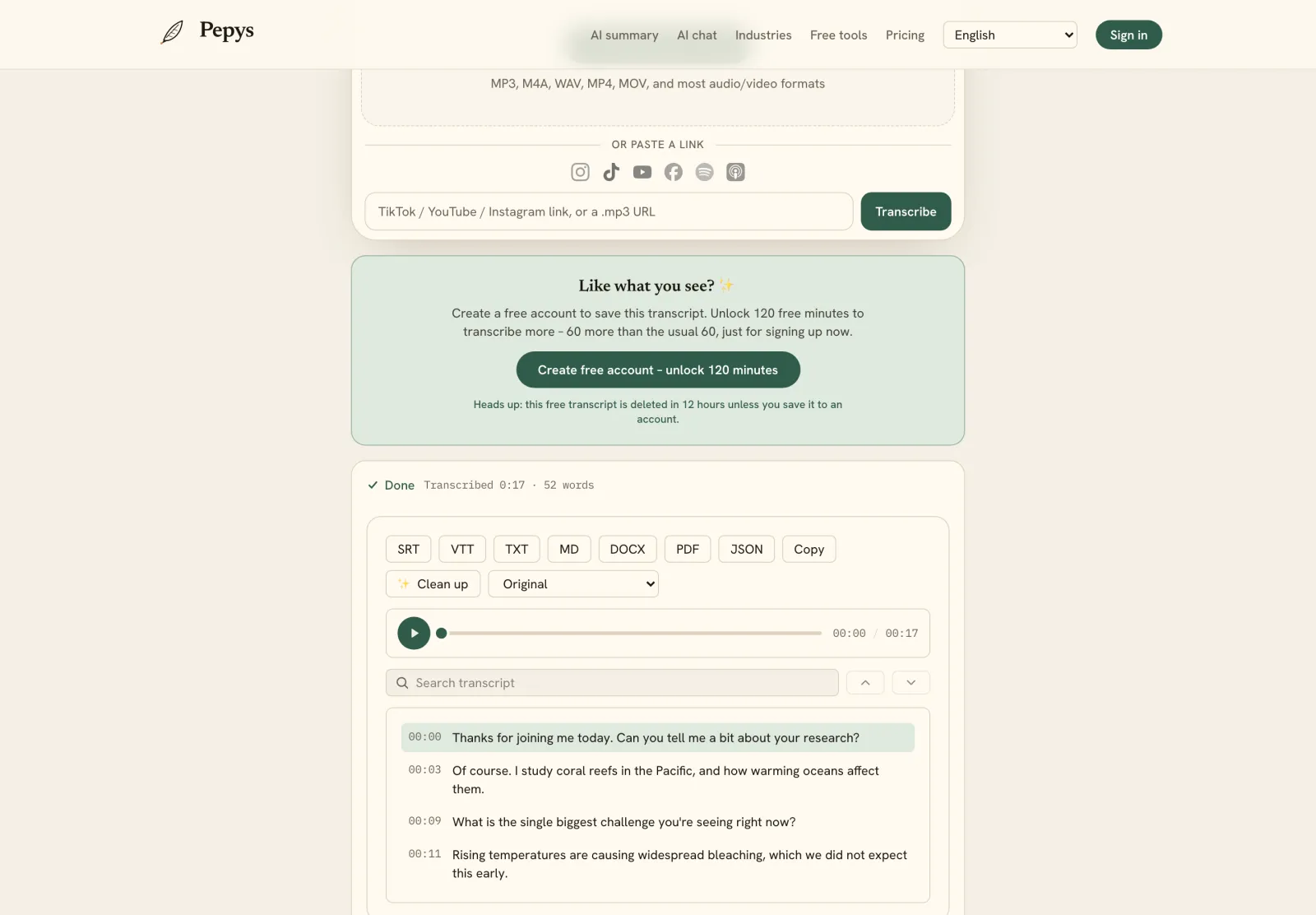
For audio-only content, a podcast episode, a recorded call, or an audio-only lecture, the compliant artifact is a transcript. Produce a clean text alternative or transcript that carries the words, the speaker turns, and any meaningful non-speech sound. That single file satisfies the audio-only requirement.
For video with sound, you need two artifacts: captions and audio description. Captions carry dialogue and non-speech audio; audio description narrates what matters on screen for someone who can't see it. Deliver captions as a WebVTT sidecar for web players, or as SRT where a platform needs it. The caption-building and timing mechanics are a job of their own.
Standards back this up. EN 301 549 clause 7 requires video players to display available captions and to play available audio description for video with synchronised audio. Raw auto-captions rarely clear the bar on their own. Names, numbers, speaker turns, and non-speech cues are where they fail, so hold them to a real accuracy standard before you publish.
The standards you'll be measured against: EN 301 549 and WCAG
Conformity runs through harmonised standards, with a catch. Article 15 says products and services that conform to harmonised standards published in the Official Journal are presumed to conform. That presumption only bites once a standard is actually listed in the Official Journal for the EAA.
The relevant standard is EN 301 549, the European standard for ICT accessibility. Its current version, v3.2.1, draws heavily on WCAG 2.1 and was harmonised on 18 August 2021. That harmonisation, though, was made under the Web Accessibility Directive, not the EAA.
So treat EN 301 549 as your working target, not a settled safe harbour for the EAA. Building to its clause 7 media requirements and to WCAG 2.1 is the sensible baseline, and a newer version aligned to WCAG 2.2 is in development. Just don't assume a listed-standard presumption of conformity for the EAA is already in force. Watch the Official Journal for the EAA-specific citation.
Exemptions, disproportionate burden, and who checks compliance
Small operators get relief, but not evenly. A microenterprise is defined as fewer than 10 people, with turnover or a balance-sheet total not over EUR 2 million. Microenterprises that provide services are exempt from the service accessibility requirements.
Products are treated differently. A microenterprise selling an in-scope product gets no blanket exemption; instead, Member States provide guidelines and tools to help it apply the rules. So a very small service provider may be off the hook, while a very small product maker is not.
Everyone else can still seek relief through assessment. Article 14 lets an operator avoid a requirement that would cause a fundamental alteration or, on the Annex VI criteria, a disproportionate burden. That's a documented assessment against set criteria, not a self-declared opt-out.
Enforcement is national, and it splits by product versus service. For products, market surveillance authorities check the Article 14 assessment and compliance. For services, Member States designate authorities responsible for checking compliance. Complaints and penalties run through those national bodies, which is one more reason to read your local transposition. This is a planning map, not legal advice.