Transcription is the first step of analysis, not a clerical task
Before it is a document, a transcript is a set of decisions. Bucholtz shows that transcribing involves both interpretive decisions (what gets represented) and representational decisions (how it is rendered on the page), and that an objective transcription is not possible (Bucholtz 2000). What you leave in and what you smooth out will steer the reading that follows.
Julia Bailey makes the same point for applied health research: putting speech into written form is an interpretive process and the first step in analysing data (Bailey 2008). Treat the transcript as analysis in progress. The person who transcribes is already coding, informally, by choosing where a sentence ends and whether a laugh belongs on the page.
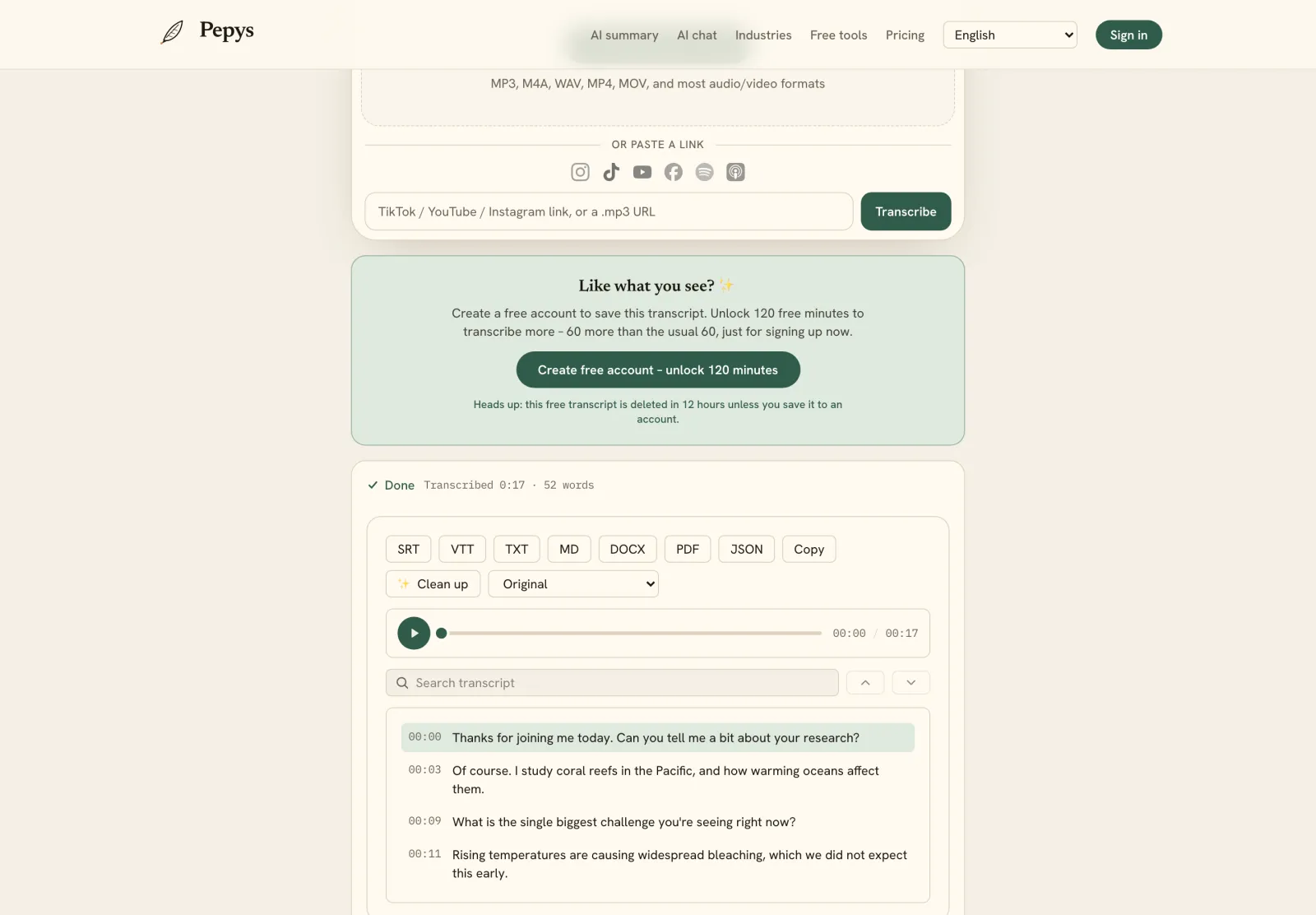
That does not mean typing every word yourself. Manual transcription can run up to six hours for a single hour of audio (Haberl et al. 2023, citing Bell et al. 2018), which is time taken away from analysis. A practical route is the AI first pass, then a careful clean that experienced interviewers use: let a tool produce a speaker-labeled draft, then read it against the audio and make the interpretive calls yourself.
Naturalized and denaturalized transcripts answer different questions
The verbatim question has a standard vocabulary. Oliver, Serovich and Mason distinguish naturalism, where every utterance is captured in as much detail as possible, from denaturalism, where grammar is corrected and interview noise like stutters and pauses is removed (Oliver, Serovich & Mason 2005). Neither is more correct; they suit different analyses.
Match the style to your method. Conversation analysis and discourse work need a naturalized transcript, because pauses, overlaps and false starts are the data. Thematic or content analysis usually reads better denaturalized, where the focus is what participants mean across cases. Decide before you edit, since retrofitting one style onto the other means re-listening to everything.
Whatever you pick, apply it to every transcript in the study so cases stay comparable. If you are writing up a thesis, a dissertation methods chapter has to justify that choice and show an examiner how much transcription detail you kept.
Which transcription conventions should you document?
Rigor here is mostly about what you write down. Poland argued that transcription quality is an aspect of trustworthiness, and that methods sections should report the steps taken to ensure audiotape quality, the directions given to transcribers, and an assessment of the transcript's trustworthiness (Poland 1995). A reviewer cannot judge a transcript when the making of it is invisible.
For any project with more than one transcriber, write the rules down. McLellan, MacQueen and Neidig note there are no universal transcription formats adequate for all qualitative data, so teams need systematic, documented procedures for preparing text (McLellan, MacQueen & Neidig 2003). A one-page style sheet settles the recurring questions.
Cover the decisions that come up on every line: how you mark pauses and overlaps, whether you keep fillers, how you spell non-standard speech, what a laugh or an [inaudible] gap looks like, and how you label speakers. Store that sheet with the data so a second coder, or your future self, transcribes the next file the same way.
Anonymization and consent set the boundaries of what you keep
Most qualitative recordings are human-subjects data. Under the Common Rule, a human subject is a living individual an investigator studies, and identifiable private information is information for which the subject's identity may readily be ascertained (45 CFR 46.102). A transcript full of names, employers and places is exactly that kind of information.
If your data touch health information, the HIPAA Safe Harbor method lists 18 identifiers that must be removed, from names through any other unique identifying code (45 CFR 164.514). Even outside HIPAA, that list is a useful checklist for what to strip from a transcript before it circulates.
For EU participants, remember that pseudonymization is a weaker safeguard than anonymization. GDPR Recital 26 states that pseudonymized data still counts as personal data, and only truly anonymized data falls outside the rules (GDPR Recital 26). In practice, replace names with role labels as you clean the draft, keep an access-controlled master with the real identities, and use a tool that does not train on your files. Pepys never trains on your audio or transcripts and requires an account before provider-backed transcription starts.
Preparing a qualitative research transcription for coding
Coding starts from a clean, speaker-attributed file. Get the interview or focus group down to a speaker-labeled first-pass draft with timestamps, correct whatever the tool misheard against the audio, then decide on your import format before you leave your editor.
Your CAQDAS software is particular about formats. NVivo imports plain text, CSV/TSV, rich text or Word, with an optional speaker-name column. ATLAS.ti accepts .doc, .docx, .rtf, .odt and .txt. Dedoose supports .doc, .docx, .rtf, .txt and .pdf. A DOCX export is the safe common denominator across all three, so a single file imports cleanly whichever package your team uses.
Get those four decisions right, style, conventions, anonymization and export format, and the transcript will hold up when a reviewer asks how it was made.