Pepys

Guide

How to cite an interview in APA, MLA, and Chicago

A practical guide for researchers, students, and journalists: which interviews go in the reference list, which stay in-text, and the exact format in each style.

The short answer

An interview goes in the reference list only if a reader can retrieve it. An interview you conducted that isn't recoverable is a personal communication: cite it in the text only. A published or recorded interview (podcast, article, broadcast) is cited by the format of its source, with the interviewee as author. APA, MLA, and Chicago each word this slightly differently.

The retrievability test decides everything

Before you choose a template, ask whether a reader can get to the interview. That one test sorts every citation. An interview you conducted, one that lives only on your recorder, counts as a personal communication in APA and Chicago. You cite it in the text or a note, and you keep it out of the reference list. A published or broadcast interview has a home a reader can reach, so you cite it by the format of that home.

One case breaks the rule. If you interviewed people for your own original research, APA says not to cite them as personal communications; you quote them directly from your data. That distinction matters most in a thesis, so the dissertation transcription guide covers it in depth. For a journalist quoting a source off your own recording, the personal-communication rule still holds.

Every clean citation starts from a clean transcript. If you're still turning the audio into text, the interview transcription workflow gets you a speaker-labeled, timestamped draft first, so the wording and the attribution are both right before you format anything.

Citing an interview in APA

In APA, split it by retrievability. An interview a reader can't retrieve is a personal communication, cited in text only. APA's guidance gives the format (Initials Surname, personal communication, Month Day, Year), with examples like (T. Nguyen, personal communication, February 24, 2020). It never enters the reference list, so the in-text note is the whole citation.

A recorded interview a reader can reach is cited by the format of its source. APA's post on nonrecoverable sources says it's preferable to cite works that are recoverable, so a recoverable interview gets a reference-list entry in the format for that source type. A podcast interview is cited as a podcast episode, a magazine Q&A as an article, a filmed one as a video.

A recorded episode gets a full reference-list entry. APA's podcast references page formats it under the host with a bracketed label: Hannah-Jones, N. (Host). (2019, September 13). How the bad blood started (No. 4) [Audio podcast episode]. In 1619. The interview sits inside the show, so the show is the container you cite.

Quoting a line from the audio? APA tells you to give a time stamp for the start of the quotation in place of a page number. A timestamped transcript hands you that number directly, so you're not scrubbing the file to find it.

Citing an interview in MLA

MLA does list the interview you conducted, which is where it parts ways with APA. The MLA Style Center places it in the Works Cited under the interviewee's name, with the descriptor Interview and a Conducted by line: Walcott, Derek. Interview. Conducted by Susan Lang, 22 Oct. 2002.

A published or broadcast interview treats the interviewee as the author and cites the interview inside its container. MLA's example of an interview in an edited collection reads: Saro-Wiwa, Ken. "English Is the Hero." No Condition Is Permanent: Nigerian Writing and the Struggle for Democracy, edited by Holger Ehling and Claus-Peter Holste-von Mutius, Rodopi, 2001, pp. 13–19.

Work from the current edition. The ninth edition of the MLA Handbook was published in April 2021, and its core-elements template uses Interview with a Conducted by supplement. Older guides that still print the Personal interview descriptor are out of date.

Citing an interview in Chicago (CMOS 18th edition)

Chicago keeps an unpublished interview out of the bibliography. The CMOS 18th citation guide groups it with personal communications, which are usually cited in the text or a note only and rarely listed in a bibliography. In practice, the interview appears in a note with the interviewee and date, and a bibliography entry stays optional.

A published or broadcast interview, by contrast, is cited by its source. CMOS's example of a radio interview puts the interviewee first as author, with an Interview by line: Buolamwini, Joy. "'If You Have a Face, You Have a Place in the Conversation about AI,' Expert Says." Interview by Tonya Mosley. Fresh Air, NPR, November 28, 2023. Audio, 37:58.

To point at a moment in a recording, Chicago uses a time stamp the way it uses a page number. The CMOS Q&A notes that time stamps save a reader hours of searching for the quoted material. And use the current edition: CMOS announced its 18th edition for September 2024.

How do you quote the words themselves?

Formatting the citation is only half the job; the quote has to be exact. APA's rule on errors in quotations is strict: a quotation must match the source's wording, spelling, and interior punctuation, even when the source is wrong. You mark the error with [sic] in brackets instead of fixing it quietly.

That only works if you're citing the exact words. Read the quote against the audio before you commit it, or pull the timestamped quote straight from the transcript so the wording and the start time are both locked. A misquote with a flawless citation is still a misquote.

Across all three styles, a start-time stamp does the locating work a page number does in print. Keep those timestamps in your transcript. An editor or fact-checker can then jump to the exact line and hear it in context, which is what makes a quote defensible.
The steps, in order

  1. 01

    Check whether the interview is retrievable

    Decide if a reader can reach the interview. If it lives only on your recorder, it's a personal communication; if it's published or broadcast, you'll cite it by its source format.

  2. 02

    Pin down the people, medium, and exact date

    Collect the interviewee and interviewer names, where the interview appears (podcast, article, broadcast, or a private recording), and the fullest date you have.

  3. 03

    Pick the pattern for your style

    In APA, an unretrievable interview is in-text only; MLA lists it in the Works Cited under the interviewee; Chicago cites it in a note. Published interviews follow the source's own format in all three.

  4. 04

    Verify the quote against the audio

    Match the source's wording, spelling, and interior punctuation exactly, and mark any error with [sic] instead of correcting it silently.

  5. 05

    Add a timestamp for any direct quote from a recording

    Use the start time of the quotation in place of a page number so a reader can find the exact moment being quoted.

  6. 06

    Build the in-text citation and any list entry

    Write the in-text citation, then add the reference-list, Works Cited, or note entry only when the style you're using calls for one.

Tips from people who do this a lot

  • The whole decision hinges on one word: retrievable. A source's private answer to you is a personal communication; the same answer published in a magazine is an article citation.

  • APA and Chicago keep an interview you conducted out of the reference list or bibliography. MLA is the outlier that lists it under the interviewee's name.

  • Never cite your own study participants as personal communications. Quote them directly from your data instead, and reserve the personal-communication form for outside sources.

  • Give the most exact date you can. 'Personal communication, February 24, 2020' beats a vague year, because it's the only locator a reader gets.

  • Keep a start-time stamp on every quotable line. In APA it replaces the page number, and in Chicago it does the same locating job.

Try it now

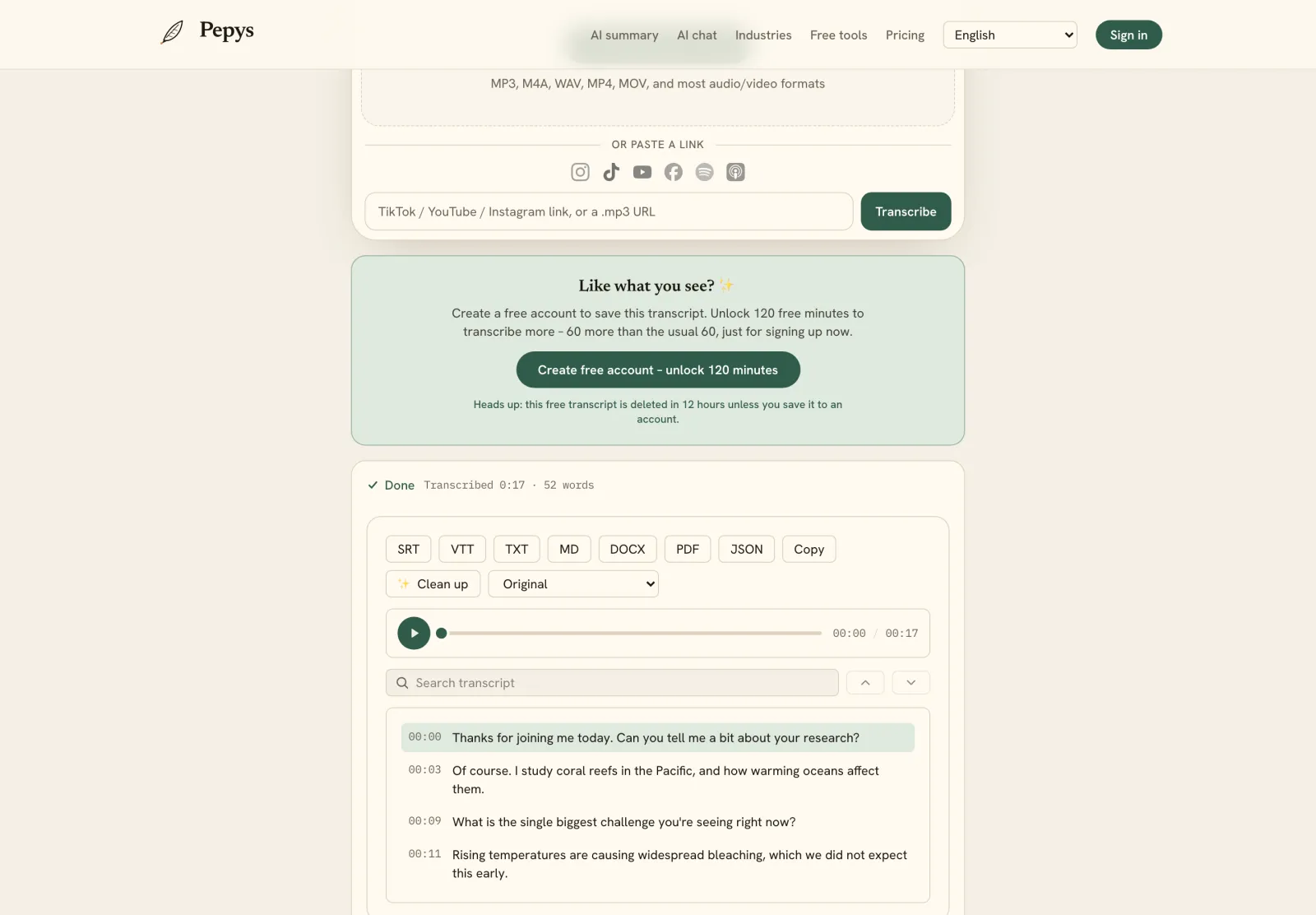
Drop in your recording or paste a link and get a clean, speaker-labeled transcript in minutes. Your first 60 minutes are free.

or paste a link
InstagramTikTokYouTubeFacebookSpotifyApple Podcasts

60 min free · no card required · we never train on your audio

PodcasterJournalistContent creatorResearcherStudent
Trusted by 100,000+ creators, podcasters, journalists & researchers

How to cite an interview in apa – questions, answered

Do you put an interview you conducted in the reference list?

In APA, no. An interview a reader can't retrieve is a personal communication, cited in the text only with the format (Initials Surname, personal communication, Month Day, Year), and left out of the reference list. MLA is different: it lists a personal interview in the Works Cited under the interviewee's name.

How do you cite a podcast or recorded interview in APA?

By the format of the source, not as a generic 'interview.' A recorded, recoverable interview gets a reference-list entry in the template for its type, so a podcast interview is cited as a podcast episode with a bracketed [Audio podcast episode] label and the host or interviewee as author.

What is the MLA format for a personal interview?

List it in the Works Cited under the interviewee's name, with the descriptor 'Interview' plus a 'Conducted by' line and date, for example: Walcott, Derek. Interview. Conducted by Susan Lang, 22 Oct. 2002. The ninth edition dropped the older 'Personal interview' wording.

How does Chicago cite an interview you conducted?

In a note, not the bibliography. Chicago's 18th edition groups an unpublished interview with personal communications, which are usually cited in the text or a note only and rarely listed in a bibliography. A published or broadcast interview, though, is cited by its source.

How do you cite a direct quote from an interview recording?

Give a timestamp for the start of the quotation in place of a page number. APA and Chicago both treat the time stamp as the locator a page number provides in print. Match the wording exactly, and mark any error in the source with [sic].

References

  1. 1.Personal communications: cited in text only, not in the reference list (initials, surname, exact date)American Psychological Association (APA Style)
  2. 2.Nonrecoverable sources: it is preferable to cite works that are recoverable (nonrecoverable ones cited in text only)American Psychological Association (APA Style blog)
  3. 3.Podcast references: real [Audio podcast episode] example (7th edition)American Psychological Association (APA Style)
  4. 4.How to cite sources with no page numbers: timestamp replaces the page numberAmerican Psychological Association (APA Style)
  5. 5.Quotations that contain errors: match the source exactly and flag with [sic]American Psychological Association (APA Style)
  6. 6.How do I cite an interview? (Interview. Conducted by [name], date; interviewee-as-author example)Modern Language Association (MLA Style Center)
  7. 7.What's new in the ninth edition (MLA Handbook, April 2021)Modern Language Association (MLA Style Center)
  8. 8.Chicago-style citation quick guide (personal communications; Fresh Air/NPR interview example)The University of Chicago Press (CMOS 18th ed.)
  9. 9.CMOS Q&A: time stamps function like page numbersThe University of Chicago Press (CMOS Q&A)
  10. 10.Announcing the Chicago Manual of Style 18th edition (September 2024)The University of Chicago Press (CMOS Shop Talk)

Keep reading

Don't just take our word for it.

Ask ChatGPT, Claude, or Perplexity what Pepys is and who it's for. One click, and your favorite AI does the homework.

Get your transcript – free to start

Pay as you go – credits never expire, nothing to cancel. Or start free with 60 minutes, no card.