The recording is the archival object – capture it to standard
Preservation standards set the floor before you press record. IASA-TC 04, the standard for sound and audiovisual archives, specifies uncompressed WAV or BWF at a sampling rate of at least 48 kHz, and advises 24-bit depth (IASA-TC 04 §5.7.2). MP3 and other data-reduced formats don't meet those standards, so record lossless from the start.
No tool transcribes what the microphone missed. Put the recorder close to the narrator, off any hard surface that booms, and away from HVAC vents and ticking clocks. A lavalier clipped near the collar beats a phone across the kitchen table. The same technique carries over from any interview transcription workflow: mic close, and check your levels before you start.
Open with a spoken slate: your name, the narrator's name, the date, and the place. It anchors which voice is which and timestamps the session before the first question.
Consent and rights: the deed of gift does the legal work
A deed of gift is the document that transfers rights. The Oral History Association treats it as one of the instruments that governs ownership of an interview, alongside deposit agreements and jurisdictional law. These agreements should clearly articulate the rights being transferred (OHA Archives Principles, p.15–17).
Copyright is shared by default. Under OHA guidance, an oral history is co-created, so copyright most often belongs to both the interviewer and the narrator until a signed agreement transfers it (OHA Archives Principles, p.9); the narrator owns the words they speak (OHA, For Participants). That's the general pattern, and your repository's counsel writes the actual forms.
A narrator and repository can agree to restrict an interview for a set period, even after it's been gifted. The repository must honor those access terms over the life of the interview (OHA Archives Principles, p.9, p.16). Transferring ownership and opening the interview to researchers are two separate decisions.
Label the two voices as narrator and interviewer
Oral history has its own naming convention. The Oral History Association uses narrator for the person interviewed and interviewer for the person asking, not 'Speaker 1' and 'Speaker 2' (OHA Archives Principles). Baylor's Institute for Oral History uses interviewee for that same role (Baylor Style Guide). This guide follows OHA and labels the two voices narrator and interviewer; whichever you pick, rename the raw labels once, up front.
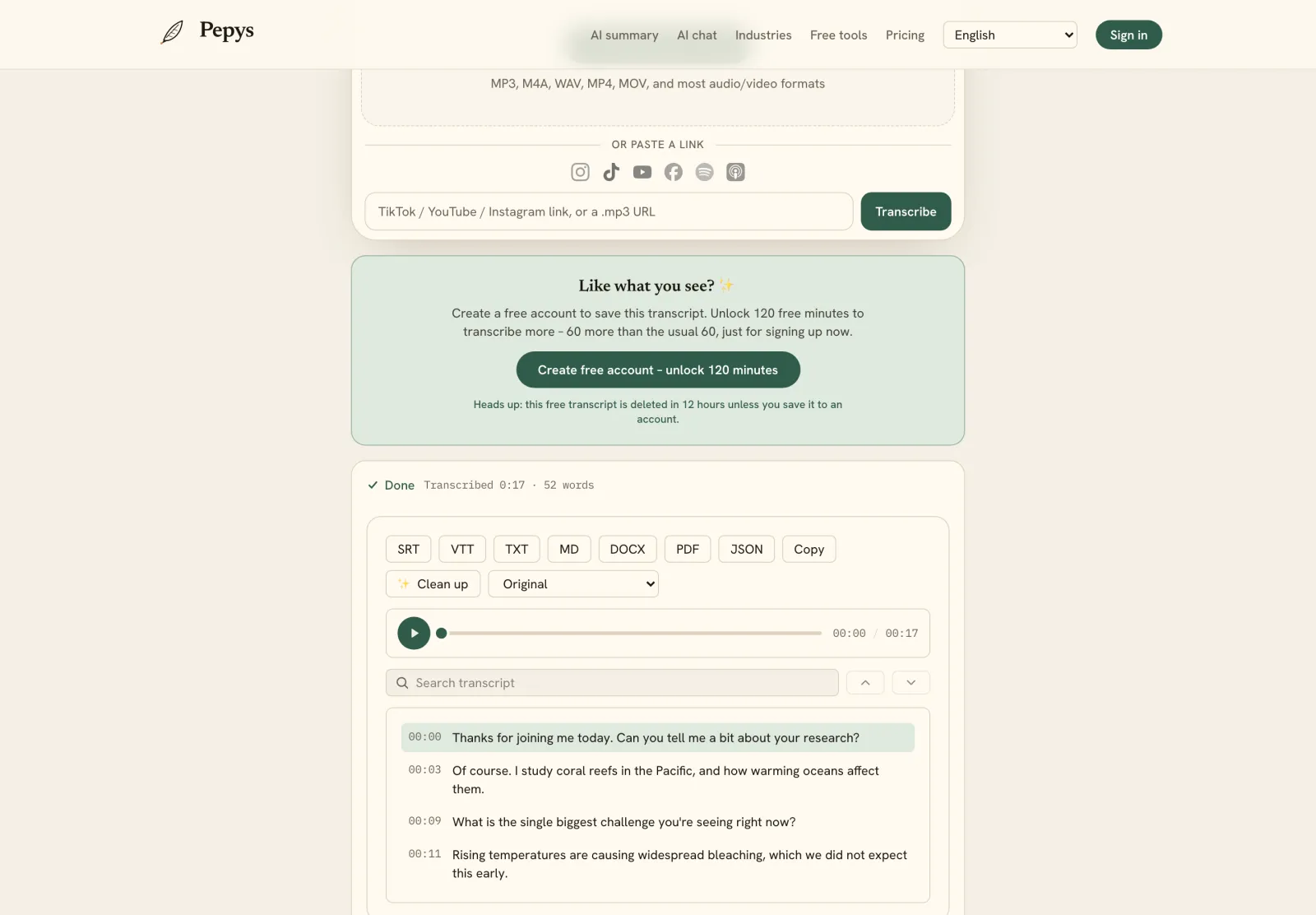
Get the split before you get the names. A diarization pass that separates the two speakers gives you a draft with the turns already broken out. You then relabel 'Speaker 1' as the narrator and 'Speaker 2' as the interviewer. Per-channel recording, one track per person, makes that split far cleaner where your setup allows it.
Most oral histories are two voices, which keeps labeling simple. Where a spouse, a second narrator, or a family member joins, name each one and note the addition. A later researcher should be able to tell who is speaking without playing the tape.
Oral history transcription is an audit-edit against the recording
Baylor's Institute for Oral History runs an 'audit-check' pass. An audit-checker or final editor listens against the recording to catch wrong words, homophones, and mishearings (Baylor Style Guide, p.4, p.16). The corrected transcript is measured against the source audio, and the edit itself stays light by design.
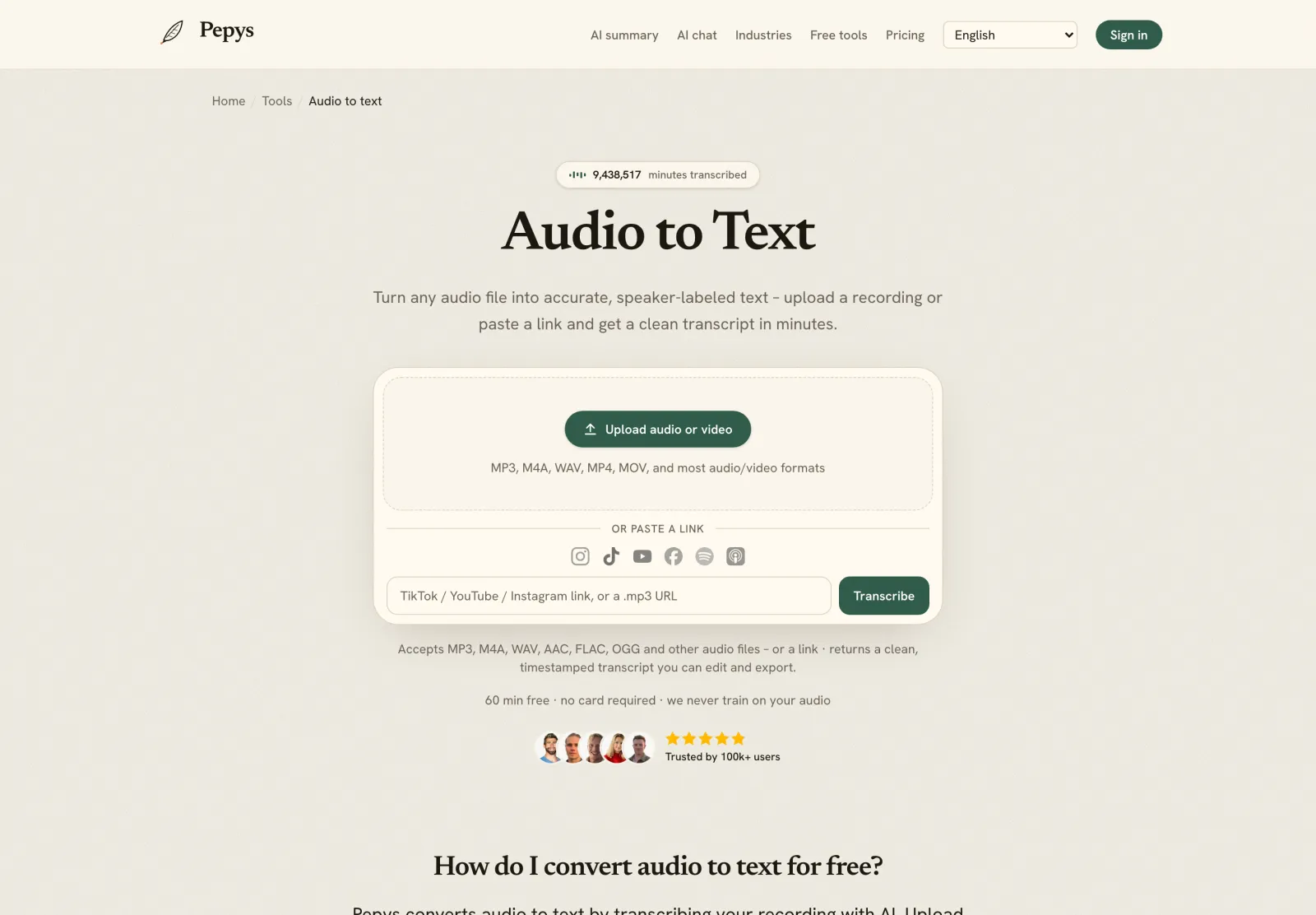
Editing a labeled draft beats typing from a blank page. Manual transcription can run up to about six hours per hour of audio (Haberl et al., 2023). Start from a speaker-labeled first pass and most of that time turns into a focused audit-edit.
Reserve square brackets for material not on the recording. In Baylor's convention, brackets hold editorial insertions the editor or reviewer adds, never the narrator's spoken words (Baylor Style Guide, p.7). Settle your editing style up front, too: an archival audit-edit sits nearer the strict end of the verbatim spectrum than a cleaned-up reading copy.
For the hard spots, follow set marks rather than guessing silently. Where the audio is uncertain, type your best guess, underline it, and add '(??)'. Where no guess is possible, leave a blank line of about the right length, then '(??)' (Baylor Style Guide, p.21). Mark overlap as '(both talking at once)' or '(speaking at same time)', never '(interrupts)', which editorializes.
On false starts and repetition, Baylor steers a middle course. Leave in enough to show individual speech patterns, keep a repetition when it carries emphasis in the voice, and don't render stuttering unless it's intentional (Baylor Style Guide, p.11). The goal is to preserve how the narrator actually spoke.
The narrator reviews the transcript before it's deposited
The narrator gets the last read. OHA's participant guidance gives the narrator a chance to review the recording and transcript, make changes, restrict access, or withdraw the interview before it's shared (OHA, For Participants). Their corrections shape the copy that enters the archive.
Baylor formalizes this as a review phase. The narrator's notes and clarifications are bracketed into the final transcript, tagged like '[Smith note: ...]', so the addition reads as the narrator's own and not the editor's (Baylor Style Guide, p.7).
Keep the corrected transcript with the recording; the audio stays the primary object. OHA directs archives to keep audiovisual components alongside transcripts, metadata, and documentation of any restrictions (OHA Archives Principles, p.8). Export the finished transcript to DOCX for an access copy, then deposit it with the master audio and the signed deed of gift.