Pepys

Guide

How to transcribe a clinical research interview

A workflow for clinical and health-services researchers who need an accurate, verbatim transcript, de-identified and handled so it never becomes identifiable PHI.

The short answer

To transcribe a clinical research interview, first confirm IRB-approved consent to record. Keep identifiable recordings out of any tool not built for PHI. For de-identified research use, get a speaker-labeled, timestamped draft, correct it verbatim against the audio. Then strip the 18 HIPAA Safe Harbor identifiers (voice prints included), and delete the raw audio under access control.

Start with IRB approval and consent to record

A clinical research interview is human-subjects research, and that changes what you do before you press record. Under the Common Rule, a human subject is a living individual an investigator studies through interaction, or by using identifiable private information about them (45 CFR 46.102). An interview is both. So your protocol, your consent, and your data-handling plan sit under an IRB's review, not just your own judgment.

You need legally effective informed consent before a participant takes part. The Common Rule requires it (45 CFR 46.116(a)), and consent is generally documented on a signed, IRB-approved form (46.117(a)). The rule's enumerated consent elements do not name audio recording. Getting explicit permission to record, and to keep the recording, is standard IRB practice rather than statutory wording – so follow the protocol your board approved.

Write down what you promised. If your consent form says the audio will be de-identified and deleted on a set timeline, your workflow has to match that. A transcription step you never disclosed is a gap an IRB can flag later.

De-identify before the file leaves your control

The safest workflow keeps identifiers out of what you share and store. HIPAA's Safe Harbor method lists 18 categories of identifiers to remove – names, dates more specific than a year, ZIP codes, and biometric identifiers including voice prints (45 CFR 164.514). Remove them and the data has no reasonable basis for identifying someone, which is the standard the rule sets.

Stripping names isn't enough, because ordinary details still combine to point at one person. Latanya Sweeney found that ZIP code, gender, and date of birth alone made 87% of Americans unique in 1990 census data. A later recomputation on 2000 data put the figure near 63%. Either way, generalize the quasi-identifiers: dates to years, locations to broad regions, rare roles to categories.

The mechanics are their own craft. Stripping direct identifiers and generalizing quasi-identifiers is done on the transcript, and you keep a separate, access-controlled key that maps codes back to people. Don't email the un-redacted version around, and don't leave it in a shared drive.

Does HIPAA apply to clinical research interview transcription?

It depends on who you are and whether the data is still PHI. HIPAA binds covered entities (health plans, clearinghouses, and providers who bill electronically) and their business associates (45 CFR 160.103). An independent academic researcher is often neither, which is an inference from those definitions, not a blanket exemption. Your IRB and grant terms may still bind you.

When PHI is involved, the rules get specific. A covered entity may disclose PHI to a business associate only with a written agreement, a BAA, giving satisfactory assurance the data is safeguarded (45 CFR 164.502(e)). Research use of PHI otherwise needs the participant's authorization (164.508) or an IRB waiver that finds minimal privacy risk (164.512(i)).

For a tool like Pepys: it does not sign a BAA and isn't for identifiable PHI, so use it only for de-identified recordings. If your file still contains PHI, that's a covered-entity and BAA question to settle first – de-identify, or keep the work inside a HIPAA-covered pipeline.

Capture the verbatim detail your analysis depends on

In a clinical interview the exact words are the data, not decoration. Transcribing by hand can take up to six hours for one hour of audio, per the aTrain study citing Bell et al. An AI first pass cuts that to minutes of processing plus focused correction, so your attention goes to verifying the lines that carry meaning.

How much you clean the wording depends on your method. If you're capturing patient-reported outcomes, keep it strict. The FDA defines a PRO as "any report of the status of a patient's health condition that comes directly from the patient, without interpretation of the patient's response by a clinician or anyone else" (2009 guidance). Tidying a participant's phrasing can quietly change what they reported.

The coding and export mechanics (naturalized versus denaturalized styles, CAQDAS-ready formatting) belong to qualitative research transcription as a craft, so this guide won't repeat them. For the first pass, a de-identified recording gives you a speaker-labeled, timestamped draft you can correct against the audio and hand to your coding software.

Handle the recording and transcript securely

Voice is itself an identifier, so the raw recording stays sensitive even after you scrub names from the text. Safe Harbor lists biometric identifiers, including voice prints, among the 18 to remove (45 CFR 164.514(b)(2)(i)(P)). That's why de-identification happens on the transcript, and the audio is tightly controlled or deleted rather than stored casually.

An IRB waiver of authorization turns on a plan to protect the identifiers and then destroy them at the earliest reasonable point (45 CFR 164.512(i)). Build that into your process: access-controlled storage, a set deletion date for raw audio, and written assurance the data won't be reused. Pick a tool that doesn't train on your files and lets you delete them after processing; Pepys does both.

Keep the un-redacted master and the code key separate from the working transcript, each under its own access control. If you ever need to verify a quote against the original, you can – without that recording drifting through email or a shared drive.
The steps, in order

  1. 01

    Confirm IRB approval and consent to record

    Check the study protocol is IRB-approved and participants gave documented informed consent, including explicit permission to be audio-recorded, before collecting anything.

  2. 02

    Record clean, separated audio

    Mic each speaker close, cut background noise, and record participants on their own channels where possible, so speaker labels stay accurate and crosstalk stays minimal.

  3. 03

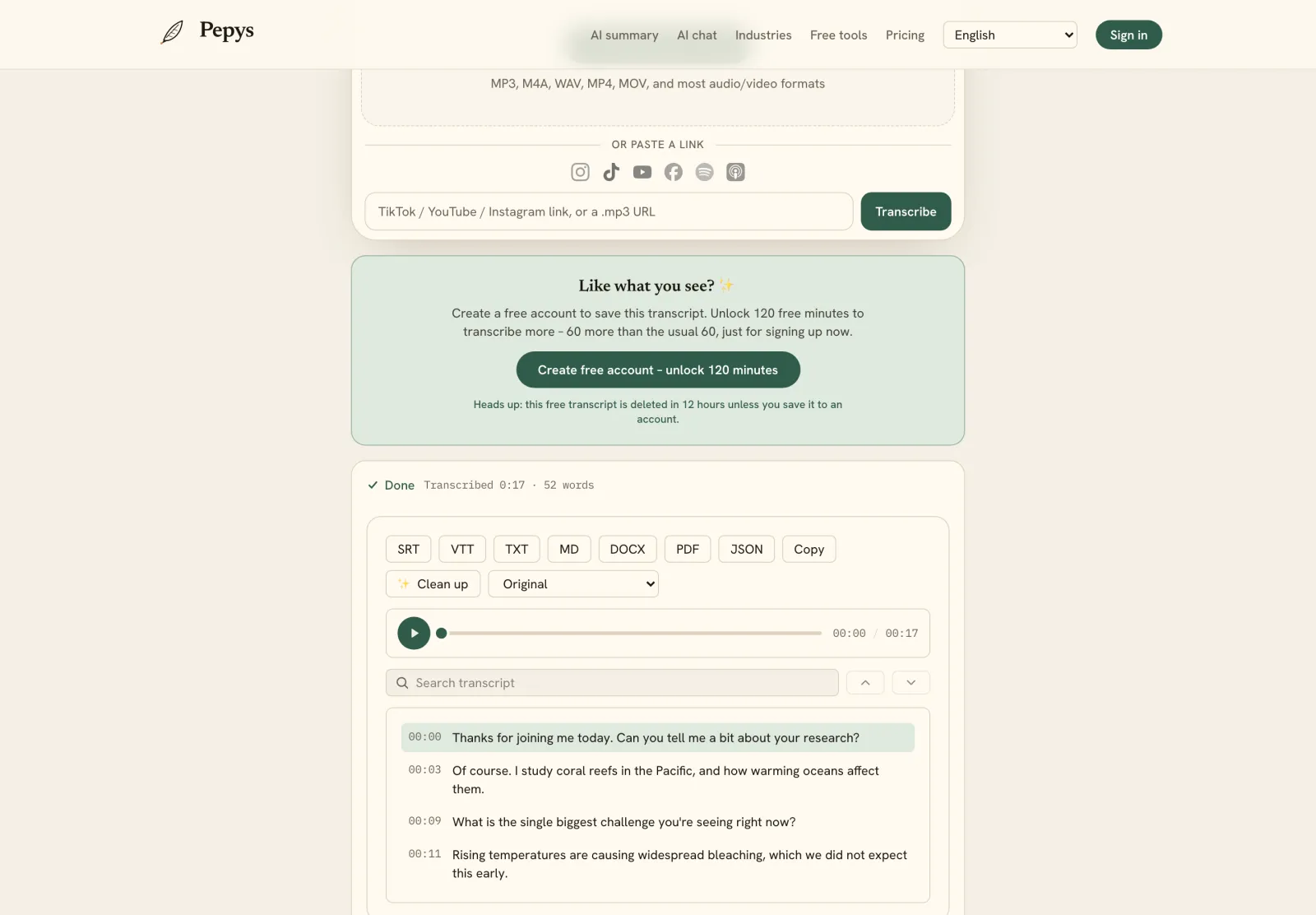
    Get an AI first-pass draft

    For de-identified research use, upload to a tool that doesn't train on your files and lets you delete them, then get a speaker-labeled, timestamped draft in minutes. Never upload identifiable PHI to a tool without a business associate agreement.

  4. 04

    Correct the draft verbatim against the audio

    Read the draft while listening, fixing names, clinical terms, numbers, and crosstalk. Keep the exact wording that carries meaning, and mark unclear passages as [inaudible] with a timestamp.

  5. 05

    De-identify the transcript and secure the audio

    Strip the 18 HIPAA Safe Harbor identifiers, generalize quasi-identifiers, and keep a separate access-controlled key. Store the master securely and delete the raw audio on your planned timeline.

Tips from people who do this a lot

  • Voice is a biometric identifier under HIPAA Safe Harbor (item P). The raw recording stays identifiable even after you scrub names from the text, which is the argument for deleting audio once the transcript is verified.

  • Keep the code key that maps IDs back to participants in separate, access-controlled storage from the working transcript. If both leak together, de-identification buys you nothing.

  • Generalize quasi-identifiers, don't just delete names. ZIP, gender, and date of birth alone can single out a majority of people, so dates become years and locations become broad regions.

  • Don't smooth a participant's wording or fix a factual slip. In a clinical interview the exact phrasing is the finding, especially for patient-reported outcomes.

  • Name the transcription tool and the deletion timeline in your IRB data-management plan up front, so what you told participants matches what actually happens to their audio.

Try it now

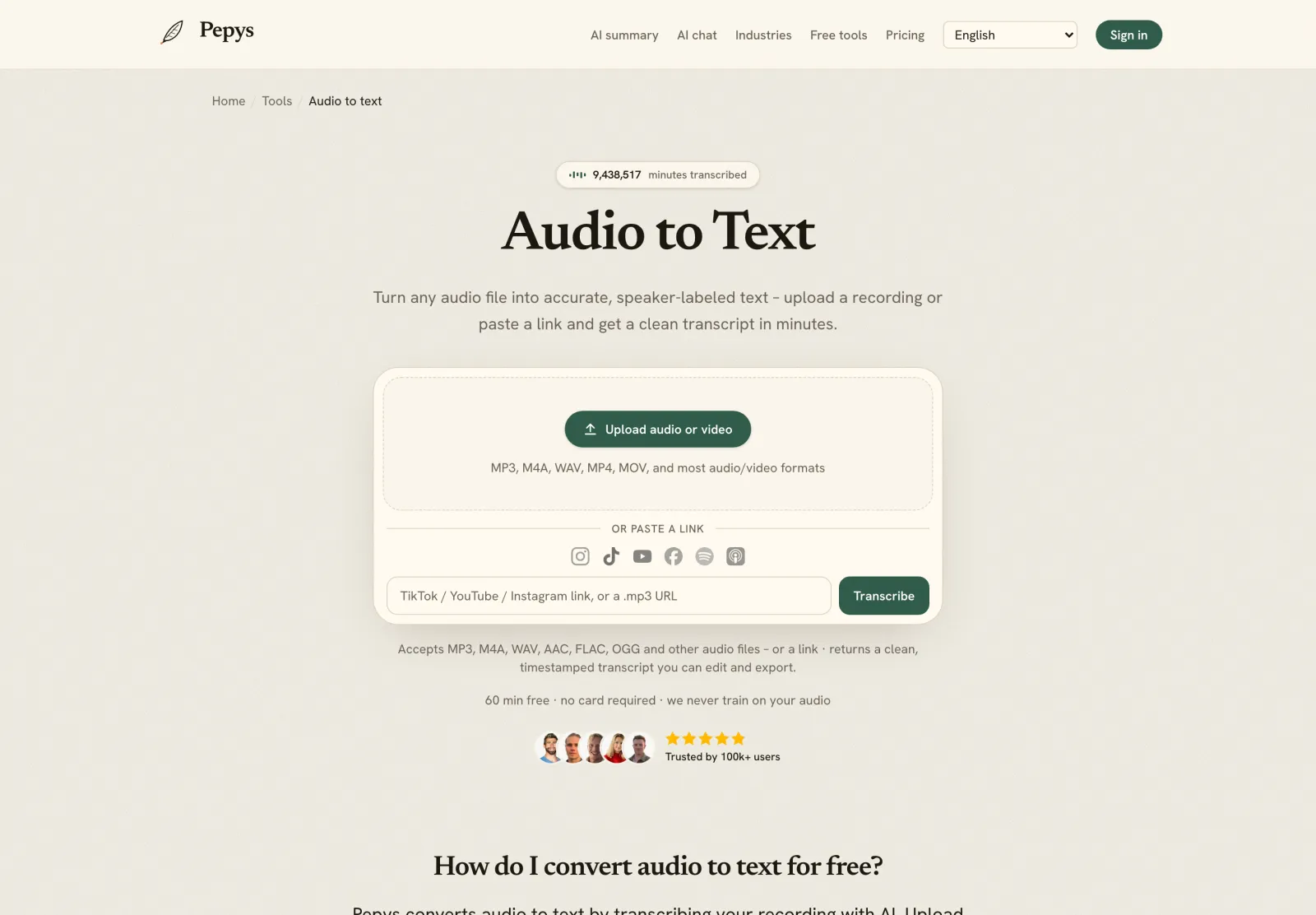
Drop in your recording or paste a link and get a clean, speaker-labeled transcript in minutes. Your first 60 minutes are free.

or paste a link
InstagramTikTokYouTubeFacebookSpotifyApple Podcasts

60 min free · no card required · we never train on your audio

PodcasterJournalistContent creatorResearcherStudent
Trusted by 100,000+ creators, podcasters, journalists & researchers

Clinical research interview transcription – questions, answered

Is Pepys HIPAA-compliant for clinical interviews?

No. Pepys does not sign a business associate agreement and is not built for identifiable PHI. Under HIPAA, a covered entity may disclose PHI to a business associate only under a written BAA (45 CFR 164.502(e)). Use Pepys for de-identified research recordings, and strip the identifiers before you upload.

What has to be removed to de-identify a transcript?

HIPAA's Safe Harbor method lists 18 categories of identifiers to remove (45 CFR 164.514(b)(2)), including names, dates more specific than a year, ZIP codes, and biometric identifiers such as voice prints. Then generalize quasi-identifiers: ZIP, gender, and date of birth together can uniquely identify most people.

Do I need consent to record a research interview?

Yes. The Common Rule requires legally effective informed consent before a person takes part in the research (45 CFR 46.116), and it's generally documented on a signed, IRB-approved form (46.117). Getting explicit permission to be audio-recorded is standard IRB practice, so follow the protocol your board approved.

Should clinical research use verbatim or clean verbatim?

It depends on your analysis. If you're capturing patient-reported outcomes, keep it strict. The FDA defines a PRO as a report that comes directly from the patient, without interpretation by a clinician or anyone else. Cleaning wording can change meaning, so match the style to your coding method.

Can I upload identifiable recordings to an AI transcription tool?

Not to Pepys, and not before checking your IRB and HIPAA obligations. If the file still contains PHI, disclosure needs the participant's authorization or an IRB waiver (45 CFR 164.508 or 164.512(i)). De-identify the recording first, then transcribe the de-identified version.

References

  1. 1.45 CFR 46.102 – definitions of human subject and identifiable private informationCornell Legal Information Institute
  2. 2.45 CFR 46.116 – general requirements for informed consentCornell Legal Information Institute
  3. 3.45 CFR 46.117 – documentation of informed consentCornell Legal Information Institute
  4. 4.45 CFR 164.514 – HIPAA de-identification (Safe Harbor, 18 identifiers, voice prints)Cornell Legal Information Institute
  5. 5.45 CFR 164.502(e) – business associate agreement / satisfactory assuranceCornell Legal Information Institute
  6. 6.45 CFR 164.508 – authorization for uses and disclosures of PHICornell Legal Information Institute
  7. 7.45 CFR 164.512(i) – research waiver of authorization criteriaCornell Legal Information Institute
  8. 8.45 CFR 160.103 – covered entity and business associate definitionsCornell Legal Information Institute
  9. 9.FDA (2009), Patient-Reported Outcome Measures: Use in Medical Product Development to Support Labeling ClaimsU.S. Food and Drug Administration
  10. 10.Haberl et al. (2023), Take the aTrain – transcription time cost, citing Bell et al. (2018)arXiv
  11. 11.Sweeney (2000), Simple Demographics Often Identify People Uniquely – 87%Carnegie Mellon University, Data Privacy Lab
  12. 12.Golle (2006), Revisiting the Uniqueness of Simple Demographics in the US Population – ~63%Proc. WPES'06 (ACM)

Keep reading

Don't just take our word for it.

Ask ChatGPT, Claude, or Perplexity what Pepys is and who it's for. One click, and your favorite AI does the homework.

Get your transcript – free to start

Pay as you go – credits never expire, nothing to cancel. Or start free with 60 minutes, no card.