A RAG system only quotes the text you give it
Retrieval-augmented generation, introduced by Lewis et al. in 2020, pairs a language model with a searchable index: a retriever pulls relevant passages, and the model grounds its answer in them. For audio and video, that index is your transcript. Whatever the transcript says is what the model has to work with.
So a sloppy transcript becomes a sloppy answer. In a peer-reviewed study, Feng et al. (2022) found pretrained language models degrade as ASR errors rise, across six understanding tasks, and worse as the noise grows. Retrieval itself tolerates some error, but the model still reads whatever mistakes are in the text and passes them along.
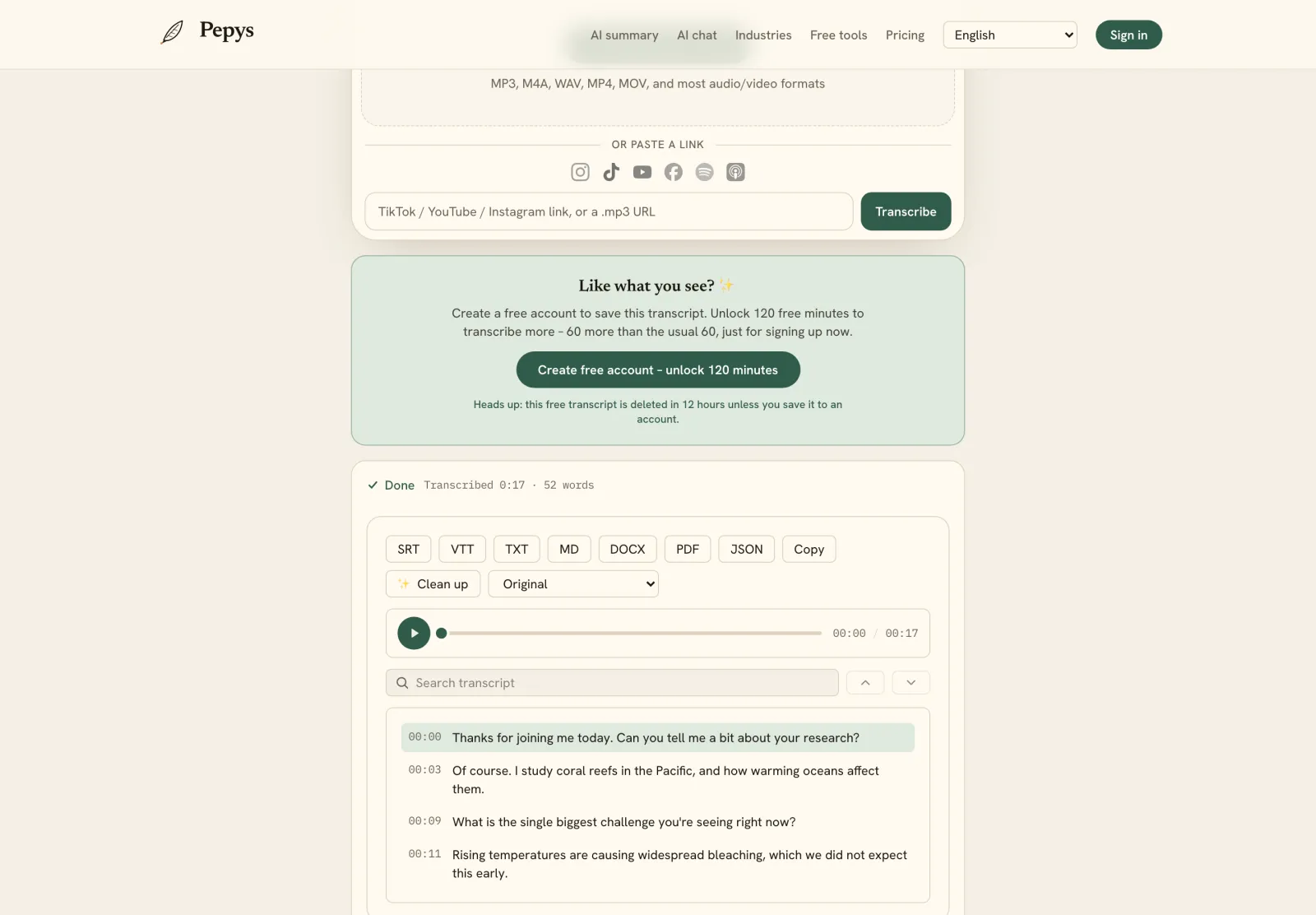
Fix the text before you index it. Turn the recording, or a pasted link, into an accurate, timestamped transcript, then correct the proper nouns, acronyms, and numbers. Retrieval leans on those exact strings, so one bad spelling can bury a passage that should have ranked.
Timestamps and speaker labels are retrieval metadata
A vector store lets you attach key-value metadata to each chunk and filter on it at query time. Pinecone's documentation names document_id, document_title, and chunk_number as example fields, which is how a generated answer points back to its source.
For a transcript, add speaker and timestamp as your own metadata fields. Now every retrieved chunk carries who said it and when, so the model can attribute a claim to a person and a moment, and you can jump straight to that second in the audio to verify it. Speaker-labeled turns give you both the labels and the timing.
Speaker turns also make natural chunk boundaries. Splitting on a turn keeps one person's thought intact instead of straddling two voices, which keeps the chunk coherent when the model reads it back.
How big should each RAG chunk be?
Start around 512 tokens, roughly 2,000 characters, with 25% overlap, per Microsoft's Azure AI Search guidance, then tune to your content. That overlap, about 128 tokens, keeps a sentence that lands on a boundary retrievable from either chunk.
There's a hard ceiling above. OpenAI's text-embedding-3-small and -large accept at most 8,192 tokens of input; anything longer must be chunked, or truncated client-side, before embedding, or the API returns an error. Chunk size is bounded by the model above and by retrieval precision below.
Stay well under that ceiling, though. Liu et al. (2024) showed models use information best at the start or end of the context and degrade for information in the middle of long inputs. A tight, focused chunk puts the relevant line where the model actually reads it.
JSON is the format an ingestion job wants
Export the transcript as structured JSON: an array of cues, each with start, end, speaker, and text. That shape maps one-to-one onto a chunk plus its metadata, so a cue-level JSON export drops almost directly into an ingestion step.
Plain text throws away the fields you need. A flat TXT means re-deriving the speaker turns and timing you already had, by hand or with a fragile parser. Keep the structure from the first export and you never reconstruct it.
At scale, automate the whole path. The transcription API, MCP server, and signed webhooks let you send a file or a link, get structured output back, and push chunks to your vector store without a human in the loop.
What to check before you embed
Give every chunk a stable id. Pair a document_id with a chunk_number, both Pinecone's own example fields, so you can update or delete a single chunk when the source changes, and so each answer traces to one exact line rather than a whole file.
Names, acronyms, and figures carry most of the retrieval signal, so correct them first. A wrong spelling embeds far from the real question, and the chunk stays hidden. Fixing it in the transcript costs less than chasing a silent retrieval miss later.
Re-embed when you change anything upstream. Swap the embedding model or the chunk size and you re-chunk from the stored JSON and regenerate every vector, so the whole corpus is produced the same way and stays comparable.