How much does transcription cost per minute?
Human transcription runs roughly $0.70 to $2.00 per audio minute for general work, and $1.50 to $3.50+ for legal or medical, per GoTranscript's published rates. Rev charges $1.99 per audio minute; Scribie starts at $0.80. Pure AI is far cheaper: about $0.05 to $0.25 per minute.
The unit that matters is the audio minute, not the page or the finished word. A one-hour interview at $1.80 per audio minute works out to about $108 – inside the roughly $60 to $120 per audio hour GoTranscript quotes for general work. Price your project by its recording length, then pick the model that fits.
Four pricing models compete for that minute: human services billed per audio minute, AI tools billed per minute, subscriptions with a monthly minute cap, and pay-once credit packs. Each has a real per-minute cost once you do the math, and they diverge sharply depending on how much you transcribe and how often.
What human transcription actually costs
Professional human transcription costs $0.70 to $2.00 per audio minute for general content, rising to $1.50 to $3.50+ for legal or medical, according to GoTranscript. You pay for labor: transcribing one hour of audio by hand takes up to six hours of work.
That labor buys accuracy. Professional transcribers hit 5.9% word error rate on conversational speech, the benchmark AI is measured against. Whether that gap is worth roughly ten times the per-minute price depends on your material – and on how much cleanup you'll do on an AI transcription draft.
Regulated work costs more and is sometimes capped. U.S. federal courts set a maximum of $4.40 per original page for an ordinary 30-day transcript, effective October 1, 2024. That's a per-page rate, not per-minute, so a dense hour of testimony can run well past a flat audio-minute quote.
Are AI transcription tools cheaper per minute?
Yes, dramatically. Pure AI transcription runs about $0.05 to $0.25 per minute, per GoTranscript's AI-only band. Temi charges a flat $0.25 per audio minute with no subscription, and Sonix's pay-as-you-go rate is $10 per hour – about $0.17 per minute.
Subscriptions look cheaper still, but only on paper. Sonix's Core plan is $25 a month for five hours, which works out to $0.083 per minute – but only if you use all 300 minutes. Otter's Pro plan bills $16.99 a month for 1,200 minutes, an effective $0.014 per minute at full use.
The catch is the cap resets every month. Transcribe nothing in July and you still pay the full $25 or $16.99, and those minutes don't roll over. For irregular, project-based work – the pattern most research and journalism follows – a subscription you fill twice a year is far pricier per minute than the sticker rate.
The hidden costs: rush fees, speaker labeling, verbatim
Turnaround and add-ons can more than double the base rate. Scribie's Priority Processing adds $1.25 per minute for 2x faster delivery, more than doubling its $0.80 base. Faster delivery costs more, especially for completion within 24 hours, per GoTranscript, and Rev treats rush as a separate service tier.
Speaker identification is a documented cost driver you'll often pay extra for. GoTranscript lists speaker count and speaker identification among the factors that move a quote, alongside verbatim level and timestamps. Some vendors fold it into the base rate instead, so it pays to check. If your recording needs clean speaker labeling, confirm whether it's included before you compare quotes.
Verbatim style also carries a surcharge. Scribie sells a Precision Verbatim add-on, and strict verbatim – every filler word and false start – costs more than a cleaned-up transcript because it's slower to produce. Decide the level of detail you actually need before you order. Paying for strict verbatim you'll never use is money gone.
Which pricing model is cheapest for your project?
It depends on volume and regularity. If you transcribe the same heavy load every month, a subscription's effective rate – as low as $0.014 per minute on Otter Pro at full use – can win. For irregular or one-off work, per-minute AI or pay-once credits avoid paying for idle months.
The honest test is how you actually use the tool over a year. A subscription only beats per-minute pricing if you reliably fill the cap; miss a few months and the math flips. Human transcription wins when accuracy and provenance justify $1 to $2 per minute over an AI draft you clean yourself.
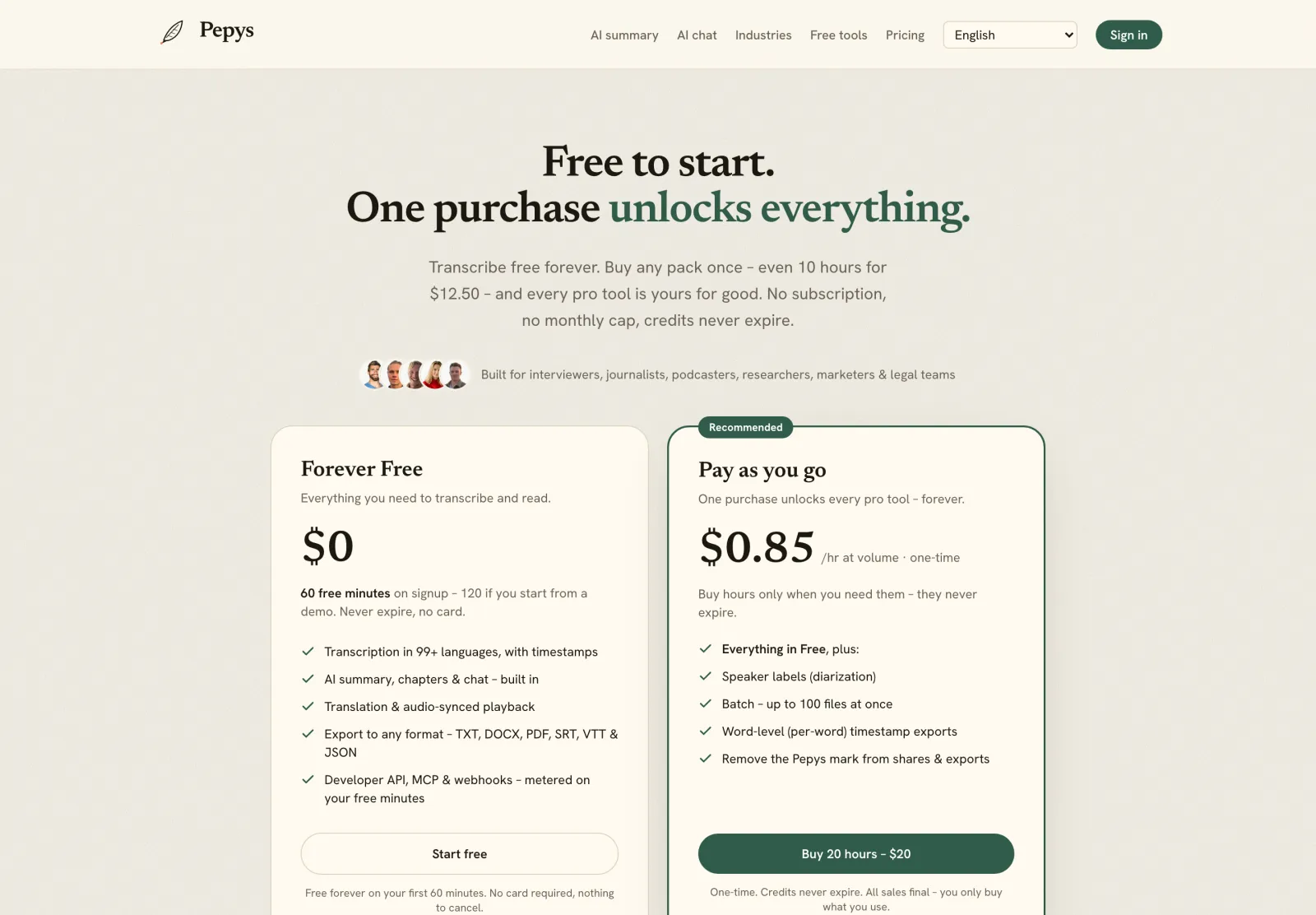
Pepys uses a pay-once model built for irregular volume: credit packs run about $1 per hour, from $1.25/hour on the smallest pack down to $0.85/hour at higher volume. You start with 60 free minutes, and credits never expire. One credit equals one minute, there's no subscription, and an idle month costs nothing.