Is transcription software worth it versus doing it by hand?
Yes, once you weigh it against typing by hand. Transcribing a single hour of interview audio can take up to six hours of manual work – close to a full working day for one recording. That's the baseline every tool is measured against. The real question is how many of those hours a tool gives back.
Put a number on that time. At the U.S. median wage of $24.51 an hour (BLS, May 2025), six hours of focused attention is about $147 of labor for every hour of audio. That's before fatigue: accuracy on hour five of manual typing is not accuracy on hour one.
The math flips fast. If you record even one hour a month – an interview, a lecture, a set of user sessions – a tool pays for itself in the time it hands back. Once you're convinced, the interview transcription workflow is the same either way: get an AI draft, then clean only the quotes you'll use.
Are free and general-AI tools good enough?
Sometimes, but the free tier has two hidden edges: hard caps and silent errors. General-AI transcription often inherits a strict input limit – OpenAI's Speech-to-Text API caps uploads at 25 MB per file, which is roughly 20 to 30 minutes of compressed audio. A one-hour interview doesn't fit in a single request.
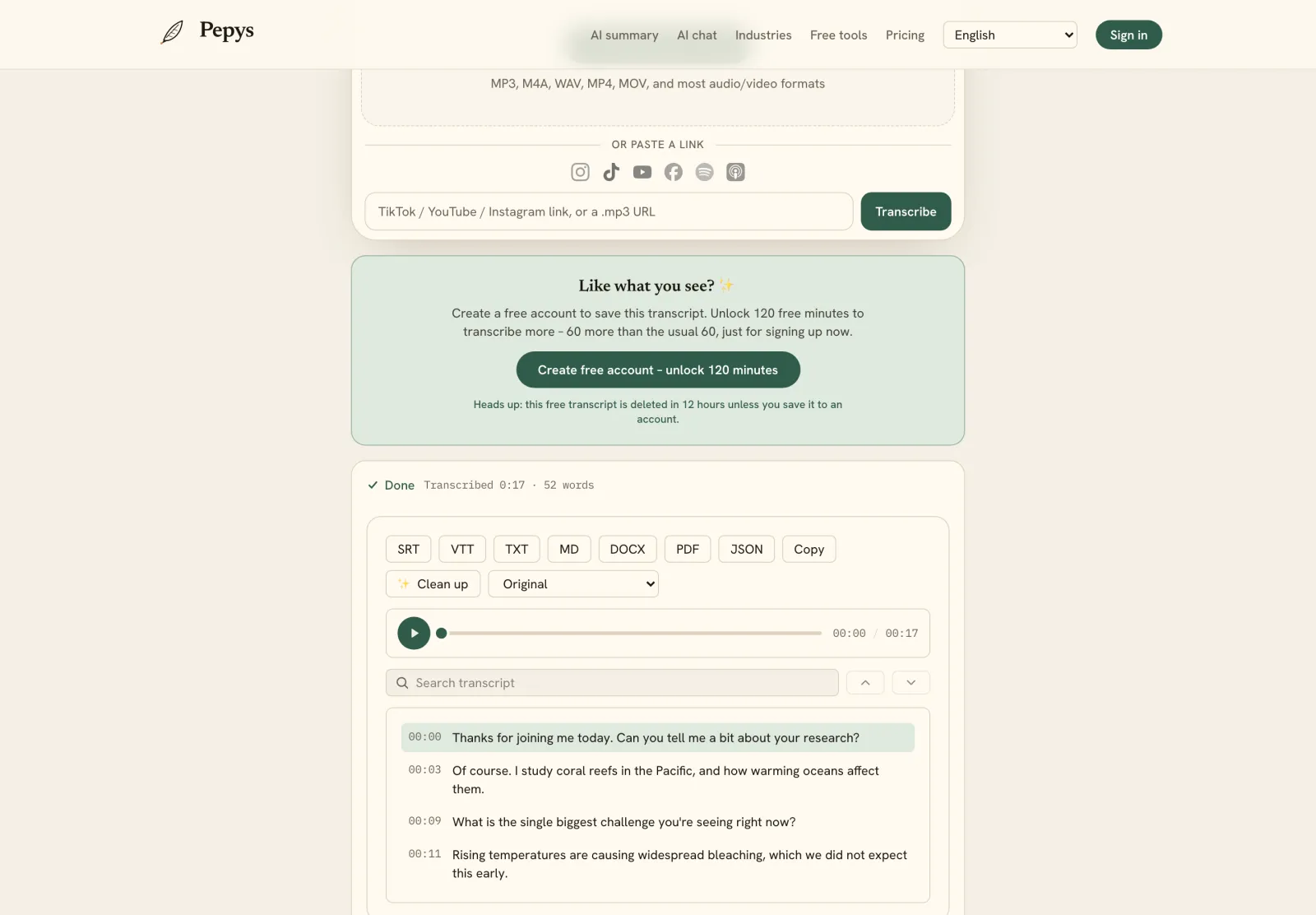
The costlier edge is trust. An audit of OpenAI's Whisper found that roughly 1% of audio transcriptions contained entirely hallucinated phrases – text that was never spoken (Koenecke et al., 2024). 'Free but unchecked' isn't free; you pay it back in fact-checking. A free tier you can actually trust is more useful: Pepys gives you 60 minutes of full-quality interview transcription free, no card.
So free tools clear a low bar: a short, disposable clip you'll skim once and delete. They struggle with length, and they can invent text you have to catch. For anything you'll publish or code against, the honest cost of 'free' is the checking time you spend catching what it got wrong.
Is AI transcription accurate enough to trust?
On clean speech, it's close to human. Microsoft Research measured professional transcribers at a 5.9% word error rate on the Switchboard benchmark and built an automated system that matched it (Xiong et al., 2016). At parity, the job changes: you're editing a draft, not re-transcribing from scratch.
That doesn't mean hands-off. Names, companies, acronyms, fast numbers, and crosstalk are where AI still slips, and those are exactly the words that carry a quote. The workflow that wins is machine-does-the-bulk, human-fixes-the-load-bearing-5%. Where a person still beats a model is exactly that 5%, so that's where your attention goes.
Accuracy also degrades with worse audio – heavy accents, overlapping speakers, a phone across the room. The parity figure is a ceiling on clean, conversational recordings, not a promise on every file. Better input is still the cheapest accuracy upgrade you can buy, before you spend a cent on software.
Pay once or subscribe – and what about hiring a human?
For project-based work, pay-once usually wins. A subscription bills every month whether you transcribe or not, so it sits idle between projects – exactly the wrong shape for research and journalism, which run in spikes. Usage-based pricing charges only for the minutes you actually run.
Hiring a person is the other end. A human transcriptionist is accurate but slow, and priced per page or per minute. U.S. federal courts cap ordinary transcripts at $4.40 per original page (Judicial Conference rate, October 2024), and private rates run higher for fast turnaround. Worth it for a legal record; overkill for a Tuesday interview.
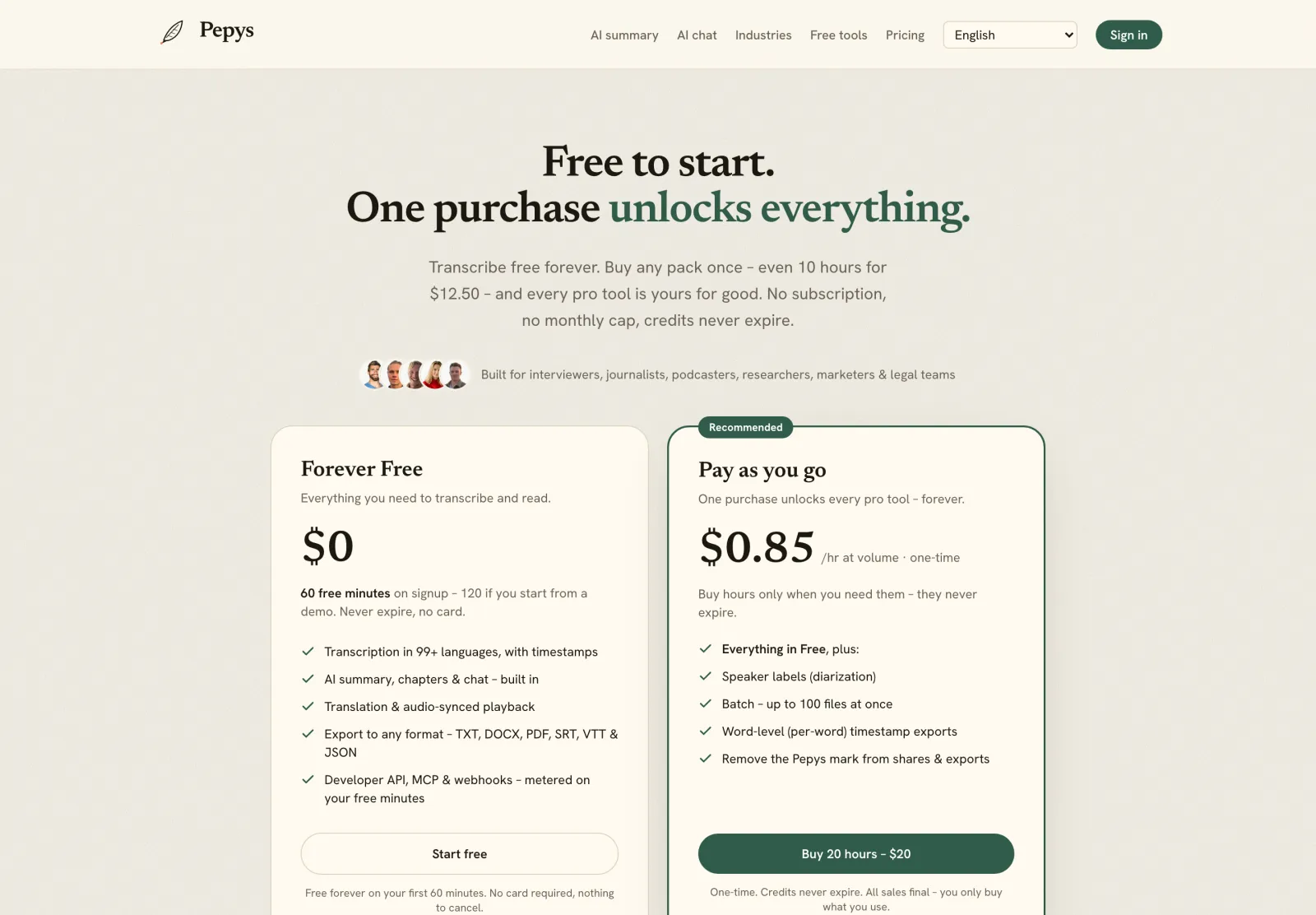
The middle path is pay-as-you-go software. With Pepys the pricing is pay-once: your first 60 minutes are free with no card, and after that you pay only for what you transcribe. Credits never expire, and your audio is never used to train a model. For bursty volume, that beats both a standing subscription and per-page human rates.
When is transcription software not worth it?
Be honest: sometimes it isn't. Picture a two-minute voice memo you'll read once and delete, no names to check, nothing to reuse. Typing it yourself beats uploading and exporting. The break-even sits where manual typing would cost you more than a couple of minutes.
The value climbs with four things: length, volume, speaker count, and whether you'll reuse the text. A one-hour multi-speaker interview you'll quote and code is the strongest case; a short monologue you'll never revisit is the weakest. Most professional recording sits well inside the 'worth it' zone.
The one clear 'no' is the clip you'd type once and forget: short and single-voice, gone the moment you've read it. Even then, price it against the hours your own typing would cost, not against zero, and the call makes itself.


