What does it cost to transcribe an interview?
Transcribing a one-hour interview costs roughly $48 to $119 through a professional human service, about $10 an hour with pay-as-you-go AI, or only your time if you type it yourself. Those three routes, human, automated, and manual, set the price band. Which one fits depends on how accurate the transcript must be and how much you value your hours.
Price tracks two things: who does the work, and how good the result needs to be. A human service reads and corrects every line, so you pay per audio minute. AI does a first pass in minutes, so you pay a small flat rate. Typing it yourself costs no cash but the thing you can least spare on a deadline, which is time.
This guide prices each route for a single one-hour interview, the unit most researchers and journalists actually work in, and it stays on cost. If you're weighing which method fits your accuracy needs, the human-versus-AI trade-off is its own decision, and the full interview transcription workflow covers the mechanics.
What do professional human transcribers charge per minute?
Professional human transcription runs about $0.80 to $1.99 per audio minute, which works out to roughly $48 to $119 for a one-hour interview before rush fees. Rev lists $1.99 per minute, GoTranscript starts at $1.02, and Scribie charges $0.80 per minute, or $48 an hour on clear audio.
What you buy at that price is a person who listens, corrects, and hits an accuracy figure vendors quote near 99%. Rush turnaround, strict verbatim styling, heavy accents, or poor audio usually add to the base rate. Treat the per-minute number as a floor, not the final invoice.
Certified legal transcription sits at the top of the range and is priced differently. The U.S. District Court for D.C. caps an ordinary 30-day transcript at $4.40 per page for the original, effective October 2024. That's a per-page rate, not per-hour: a federal page is 25 double-spaced lines, so it holds far fewer words than a minute of speech. Read it as a neutral order-of-magnitude for certified work, not a quote you'd get for a research interview.
How much is AI transcription, and when does a subscription pay off?
Automated AI transcription costs about $10 for a one-hour interview on pay-as-you-go. Sonix charges $10 per hour with no subscription, and bills overage at the same rate. That's roughly a tenth of the low end of human pricing, in exchange for a draft you clean yourself rather than a finished, corrected transcript.
Subscriptions lower the per-minute cost if you transcribe steadily. Otter's Pro plan is $8.33 a month billed annually and includes 1,200 minutes, and Rev's AI Essentials plan is $25.49 a month for 5,000 minutes. Sonix sells hours in tiers: $25 a month for 5 hours, up to $80 for 40.
The catch for project-based work is the idle month. A subscription only pays off if you fill the quota; skip a month between projects and you've paid for minutes you never used. Free tiers are thin, too, at 45 minutes on Rev or 300 on Otter, enough to test but not to finish a real interview.
What does doing it yourself actually cost you?
Typing a transcript yourself has no cash price, but the time cost is steep: one hour of audio can take up to six hours of manual work to transcribe, according to a 2023 University of Graz paper citing Bell et al. That's most of a working day spent on a single interview.
Put an hourly value on your own time and DIY stops looking free. An hour of interview is roughly 9,000 words at an average speaking rate near 150 words a minute, a widely cited benchmark. Typing, rewinding, and fixing that much text by hand is exactly the work an AI pass does in minutes.
There's a middle path most people skip: do the manual work only where it counts. Let AI produce the draft, then spend your time correcting names, jargon, and the quotes you'll actually publish. You trade six hours of typing for maybe an hour of focused editing, and the cash cost stays near AI rates.
A one-hour interview, priced across every option
For a one-hour interview the spread is wide: about $48 to $119 with a human service, roughly $10 with pay-as-you-go AI, and up to six hours of your own time if you type it. Pay-once AI transcription runs near $1 for that hour. Same recording, a hundred-fold range in price.
Here's the hour priced end to end. Human service: $48 to $119, finished and corrected. AI subscription: a slice of a $9 to $50 monthly fee, worth it only if you transcribe every month. Pay-as-you-go AI: about $10 for a draft you clean. Doing it yourself: no cash, up to six hours of your day.
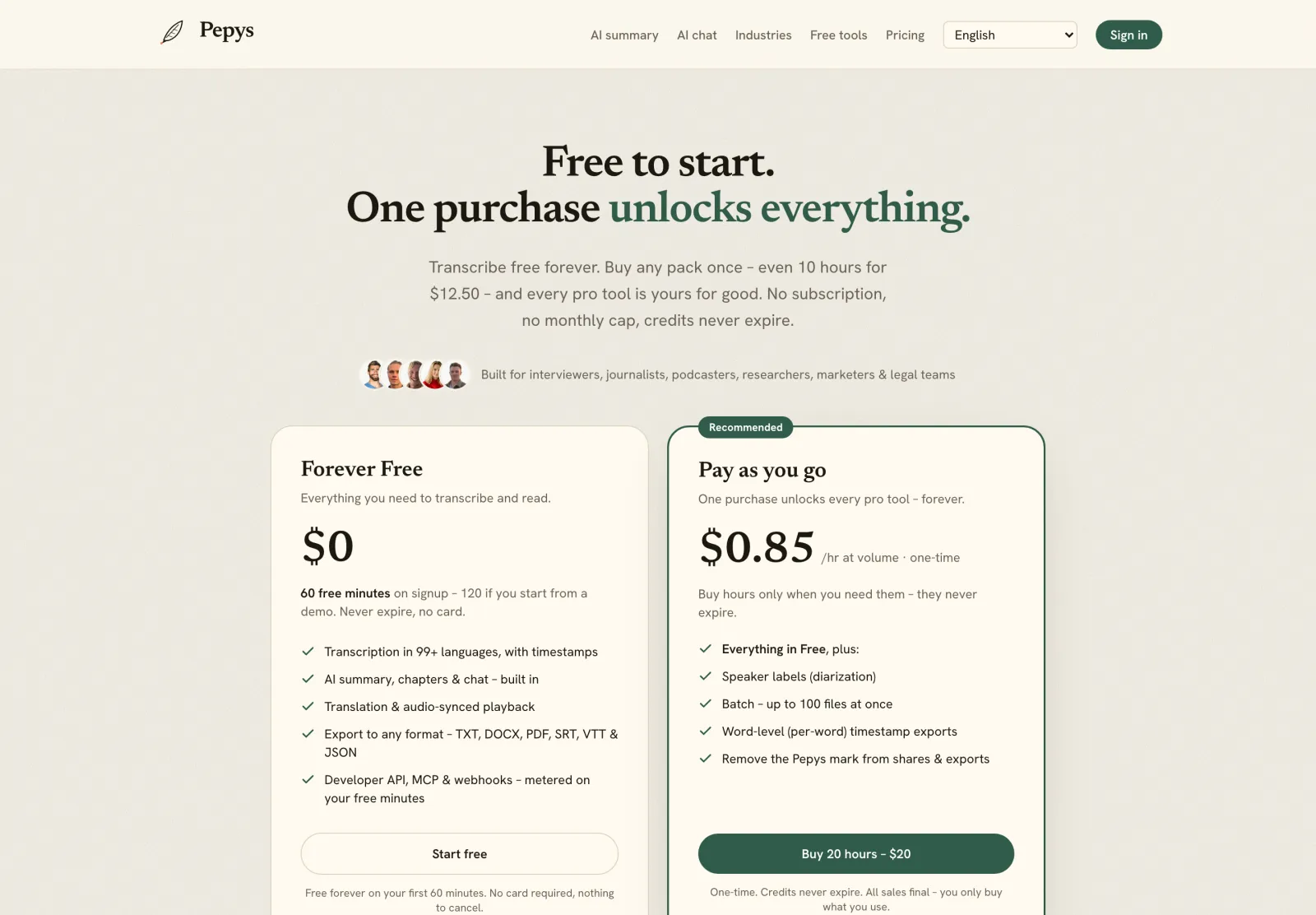
Pay-once usage-based pricing lands at the low end without any subscription. Pepys runs about $1 an hour, paid once, so a one-hour interview costs roughly a dollar, credits never expire, and the first 60 minutes are free. You get AI-draft economics with no monthly fee sitting idle between projects.
The practical move for most interviews: run an AI first pass on the interview, then edit only the quotes you'll use. You pay AI rates, spend an hour instead of six, and end with an accurate, attributable transcript. Match the spend to the stakes. Pay a human when a certified or courtroom-grade transcript is non-negotiable. Use pay-once or pay-as-you-go AI for research and journalism, where you verify the quotes yourself anyway. Reserve pure DIY for the rare clip too short to bother setting up.