Transcribe in the source language, then translate the transcript
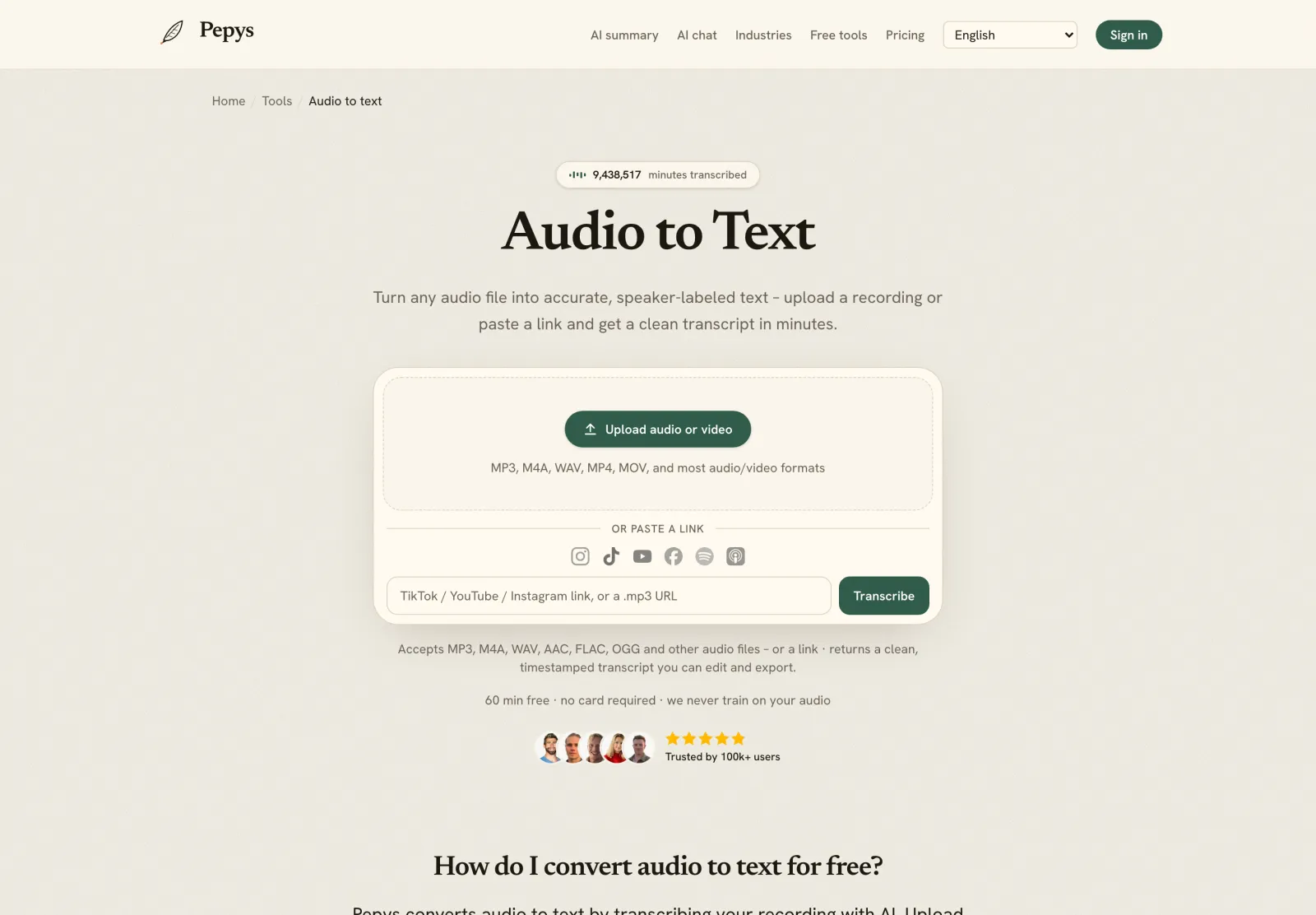
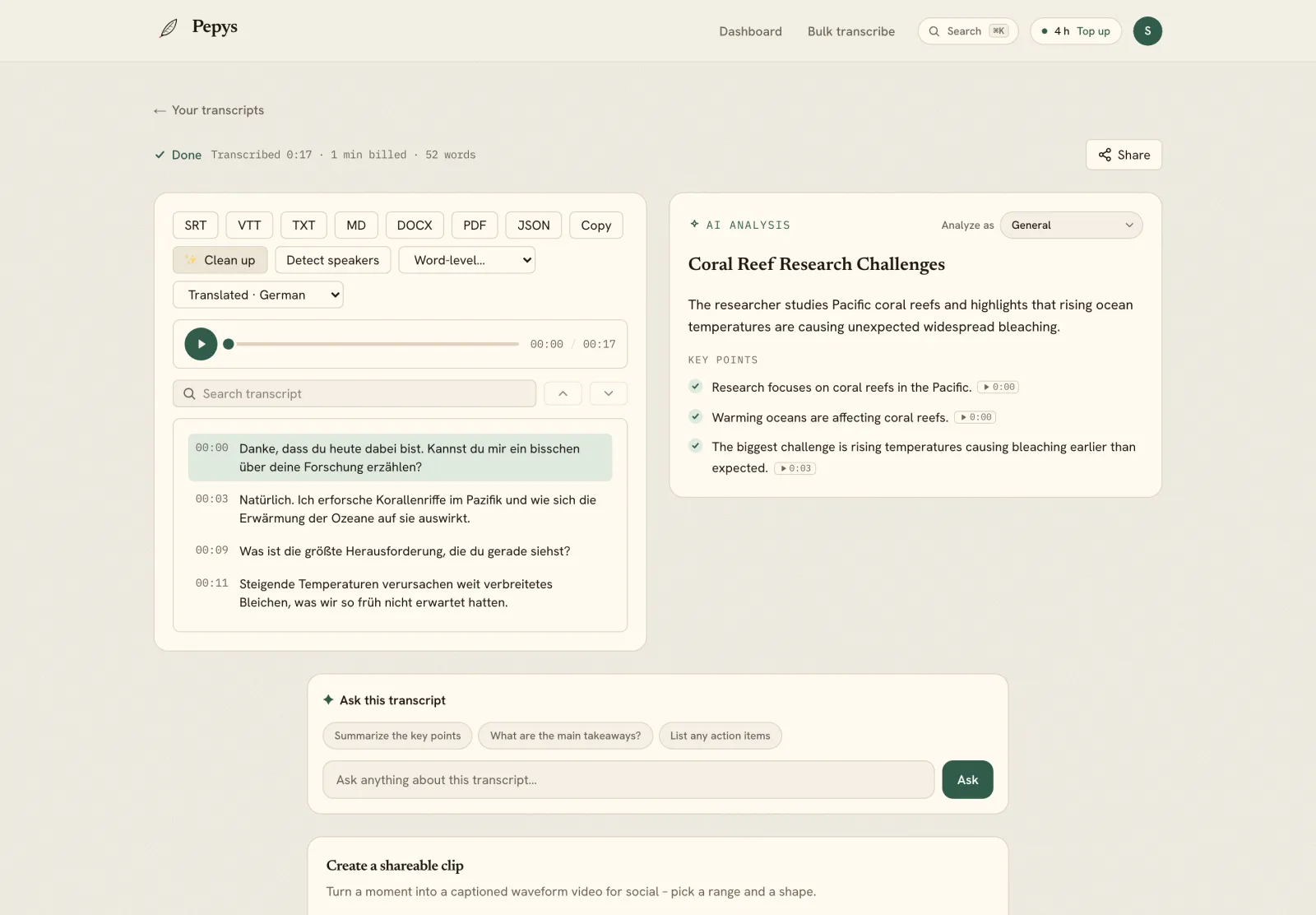
Do the transcription in the original language before you translate anything. The source transcript is the thing you translate from, so if it's wrong, the translation multiplies the error. Start with a clean, speaker-labeled draft in the source language, then translate that text – not the audio directly.
Translate segment by segment so the structure survives. A transcript translator that works cue by cue keeps every timestamp and speaker label in place, which matters more than it sounds. Flatten the transcript into one block and you lose the ability to jump back to the audio and check a line. A translated SRT subtitle file will then no longer sync to the video.
Keep speaker labels through the translation. Who said what is part of the meaning, especially in a multi-speaker interview or focus group, so preserve diarization rather than merging turns. Translate what each speaker says, not the identity: 'Speaker 1' stays 'Speaker 1' while their words change language.
Why does machine translation still need a human pass?
Machine translation reads fluently but still makes meaning-level errors a human has to catch. In a pairwise ranking experiment, raters preferred human over machine translation more strongly when judging whole documents than isolated sentences, because errors invisible at the sentence level become decisive across a document (ACL / EMNLP 2018).
Don't trust surface smoothness. A confidently phrased mistranslation of a quote is exactly the kind of error fluency hides, and it's the sort of thing that becomes a correction later. Read the passages you plan to quote against the source, ideally with a fluent speaker, before any of it goes to print.
Spend your review time where meaning is load-bearing. Negations, idioms, numbers said in passing, and named entities are the spots machine translation most often flips. Those are also the words you're most likely to quote, so that's where a human pass earns its keep.
How do you check a translated transcript is accurate?
The established check is back-translation. Translate forward, then have a second person independently translate the text back into the original language, and compare the two for meaning. Brislin's cross-cultural method built its five equivalence criteria on exactly this comparison of meaning (Journal of Cross-Cultural Psychology, 1970).
Do the back-translation blind. The person translating back shouldn't see the original source text, or they'll unconsciously reproduce it. Where the back-translation and the original diverge, that gap points you straight at the phrases whose meaning didn't carry, and you reconcile those before finalizing.
Reserve this for the high-stakes material. Survey items, questionnaire wording, and quotes headed for publication are worth back-translating; a full three-hour transcript you're only reading for understanding usually isn't. Match the rigor to how the translation will be used.
Translation is interpretation, not word-swapping
In research, translation is an interpretive act with consequences for your findings, not a neutral swap. Temple and Young argue that whether you identify the act of translation, and who performs it, carries epistemological implications for how the data gets represented (Qualitative Research, SAGE, 2004).
The translator isn't a neutral conduit. In a cross-language study, the translator becomes a producer of research data whose identity and experiences shape the analysis (Squires, 2009). Treat them as a co-analyst, not a passthrough, and record the choices they made about ambiguous or culturally loaded phrasing.
Write the translation procedure into your methods section. Name who translated, the language pair, their fluency, and how you verified equivalence. Reviewers of cross-language qualitative work expect that trail, and it's what lets a reader judge whether a translated quote can be trusted.
When do you need a certified translation?
Some uses require a certified human translation, and machine output won't do. USCIS rules require any foreign-language document to carry a full English translation the translator certifies as complete and accurate, plus a certification that they're competent to translate from that language (8 CFR 103.2(b)(3)).
Courts hold a similar line. Under the Court Interpreters Act, the Administrative Office certifies interpreter qualifications, and the presiding officer must use certified interpreters in proceedings the United States brings (28 U.S.C. 1827). The certified human record is what counts; automated output isn't a substitute.
So split the job by purpose. Machine-translate to understand a source or draft your first pass. Then commission a certified human translation only for documents that legally need one: filings, court records, and official submissions. Paying twice beats a rejected filing.