Pepys

Guide

How to transcribe a sermon

A working guide for pastors, church media teams, journalists, and researchers who need an accurate, citable sermon transcript – not an approximation.

The short answer

To transcribe a sermon, start with the closest, cleanest recording you can get, then upload it to a transcription tool for a timestamped draft in minutes. Read the draft against the audio and fix what AI gets wrong in preaching: proper names, Scripture references, and theological terms. Then clean only the passages you'll publish or turn into a study guide. Keep the timestamps so every quote is re-checkable.

Why the room, not the software, sets your ceiling

A microphone at the back of the sanctuary is fighting the room. Swapping a close, headset-style mic for a far-field room or array mic raises word error rate by about 75% relative (arXiv 2108.05520). Reverberation smears the audio in time, and the recognizer loses the edges of words. A stone or high-ceilinged sanctuary is just the kind of reflective space that does this.

The best sermon recording usually already exists: the feed from the sound desk. The lapel or pulpit mic the preacher wears is a close mic, and the board can capture it clean, before the room's echo is added on top. Ask the AV volunteer for a line-out or a post-service export instead of pointing a phone from pew twelve.

No soundboard access? Get the recorder as close to a single speaker as you can – near a PA cabinet, or a few feet from the pulpit – and off hard, echoing surfaces. A modest close recording beats a pristine recorder placed forty feet back every time.

Should you type it out or let AI draft it first?

Transcribing by hand runs up to six hours for a single hour of audio (Haberl et al., 2023) – a 40-minute sermon can eat most of an afternoon. An AI first pass turns that into a few minutes of processing plus a focused read-through, so you're correcting a draft, not typing from a blank page. Drop the file into a sermon transcription pass and you get a timestamped draft to work from.

Modern speech-to-text handles the connective tissue of a sermon well: the narrative, the exhortation, the plain English. What it fumbles is the specialized vocabulary, and preaching is dense with it. So let the machine carry the bulk, and spend your attention on the parts that carry the meaning.

When a line is genuinely unclear – a word swallowed by an 'Amen' from the congregation – bracket it as [inaudible] with its timestamp rather than guessing. A flagged gap is honest. A confidently wrong quotation of a preacher is worse than a blank.

Where does AI slip when you transcribe a sermon?

On proper names that appear rarely in training data, even strong speech-to-text keeps a real error rate (arXiv 2409.06062). Sermons are wall-to-wall with exactly those: Habakkuk, Nebuchadnezzar, Melchizedek, Antioch, plus Hebrew and Greek terms, hymn titles, and the preacher's own references. Expect the first draft to mangle them.

Watch spoken Scripture references especially closely. 'Second Corinthians five seventeen' has to become '2 Corinthians 5:17,' and a recognizer will happily write 'to Corinthians' or drop the verse entirely. When you need to pull an exact, timestamped line for an article or newsletter, a quote-focused pass keeps the citation anchored to the audio.

If the sermon has a manuscript or the preacher posts series notes, read the draft against them – names and terms fix themselves. Otherwise, correct each proper noun once and use find-and-replace: recognizers tend to repeat the same mistake, so one fix often clears a dozen.

Verbatim or readable – the style you pick changes every line

Decide your style before you edit, because it changes every line – and the choice is a real methodological one, not just cosmetics (Oliver, Serovich & Mason, 2005). Naturalism captures every utterance – repetitions, the 'come on now,' the congregation's response – as data. Denaturalism corrects grammar, removes stumbles, and standardizes delivery into clean prose.

For an oral-history archive or a study of preaching style, keep it naturalistic – the cadence and call-and-response are the point. For a printed study guide, a newsletter, or a handout, readable verbatim serves better: tidy the grammar lightly so it reads on the page without changing what was said, then export it to DOCX for the handout or the archive. Pick one style and hold it consistently.

Never quietly fix a factual slip the preacher made. If they cite the wrong chapter or misname a figure, the transcript keeps it and you mark it [sic] – the convention that signals the error is the source's, not yours – rather than editing history.

Who owns the sermon, and do you need permission?

A sermon is a protected work. The Berne Convention lists 'sermons' by name among protected literary works (WIPO, Article 2(1)), and the copyright owner holds the exclusive right to reproduce a fixed work (U.S. Copyright Office). Transcribing turns a spoken sermon into a fixed copy, so your own church's sermon is usually routine, but republishing someone else's needs thought.

Quoting a portion for commentary, criticism, or study may be fair use, but there's no safe word count or percentage – it's a case-by-case, four-factor test (U.S. Copyright Office). Posting a full transcript of another church's sermon is a different act from quoting three lines in a review. The full copyright and fair-use walk-through for spoken-word recordings lives in our lecture-transcription guide.

If you're recording a sermon yourself rather than working from the church's own file, recording-consent law can apply to conversations around it. One-party consent is the federal minimum and covers most states, but about eleven require every party to agree (Reporters Committee). A sermon preached to a public congregation is rarely private; the pastoral conversation afterward can be.
The steps, in order

  1. 01

    Get the cleanest, closest recording

    Pull the sound-desk feed or the pulpit/lapel mic if you can – a close mic beats a room mic, which adds roughly 75% more word errors. Note the date and the preacher's name.

  2. 02

    Upload it for an AI first pass

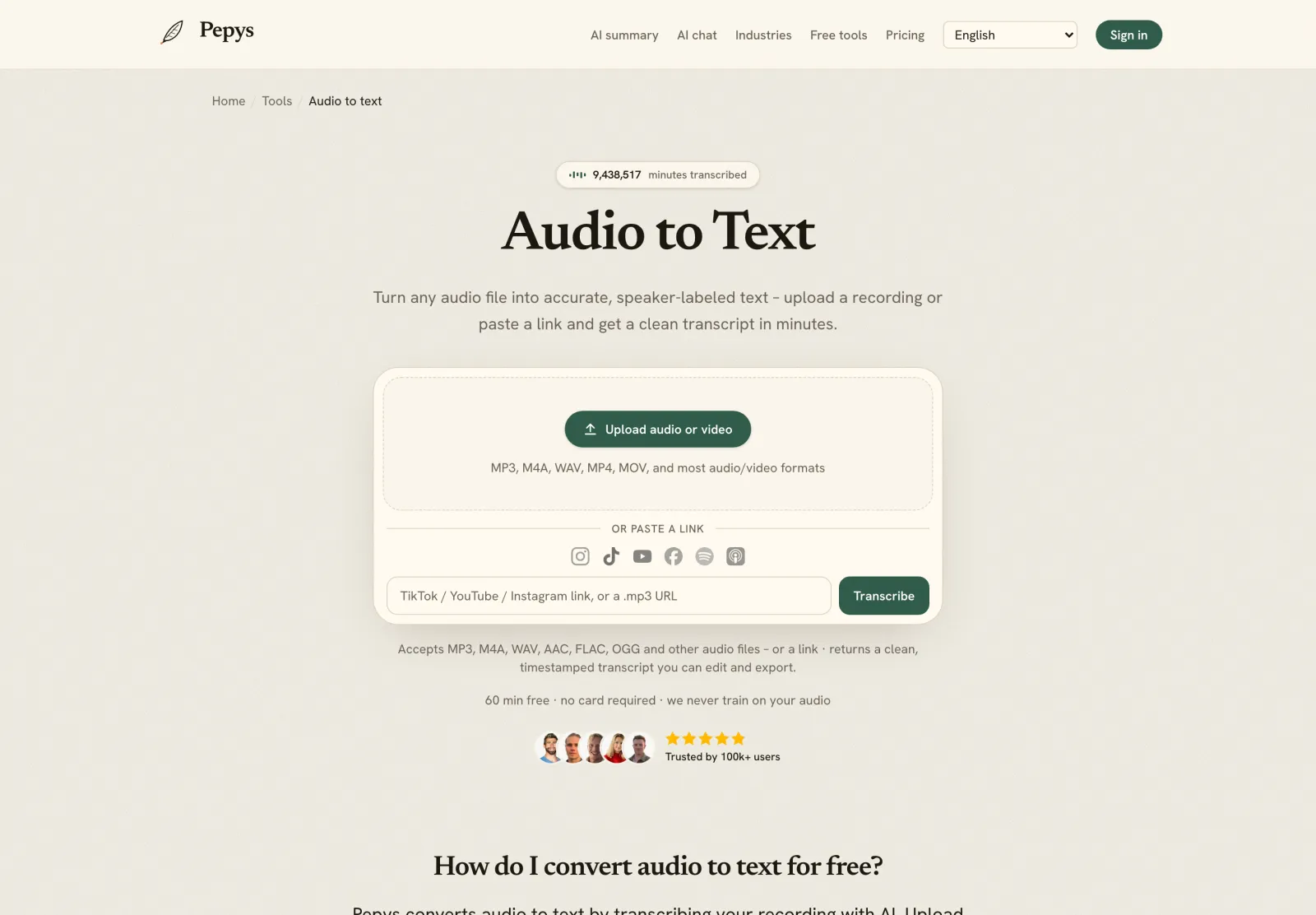
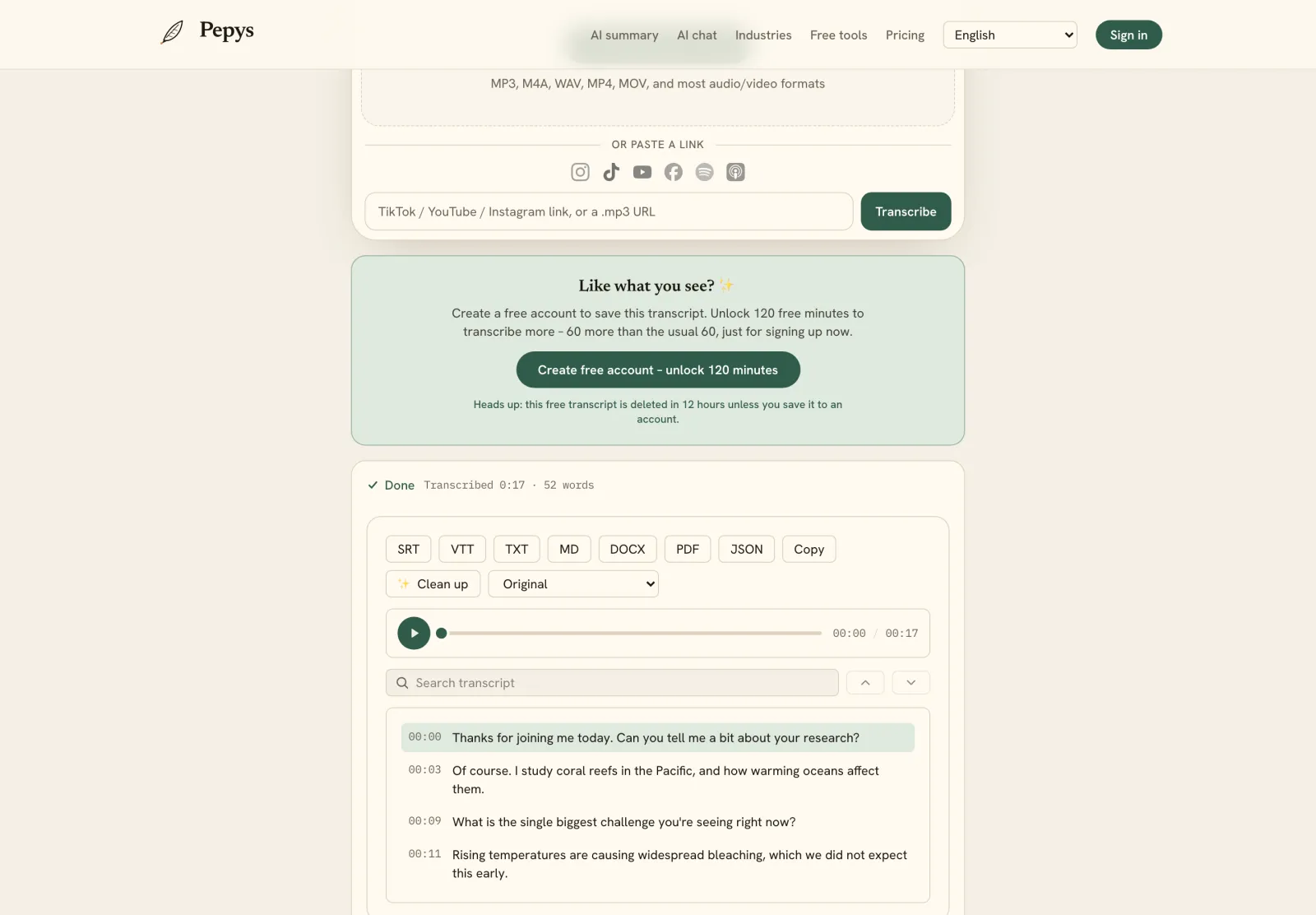
    Drop the file (or paste a link) into Pepys and get a speaker-labeled, timestamped draft in minutes instead of an afternoon of typing.

  3. 03

    Read the draft against the audio

    Fix what AI slips on in preaching: proper names, Scripture references, theological terms, and hymn titles. Mark anything unclear as [inaudible] with its timestamp.

  4. 04

    Choose verbatim or readable, then clean the quotes

    Apply one style consistently. Keep naturalistic detail for an archive, or tidy to readable prose for a study guide, focusing effort on the lines you'll publish.

  5. 05

    Export and file it

    Export to DOCX or PDF for a handout, or SRT/VTT for captions. Keep timestamps so every quote traces back to the audio, and store the master securely.

Tips from people who do this a lot

  • The sound desk already holds your best recording. A post-service line-out or export from the board beats any phone in the pews, because the board taps the close mic before the room adds echo.

  • Recognizers make the same name error every time. Fix 'Habakkuk' or 'Nebuchadnezzar' once, then find-and-replace the rest of the file in seconds.

  • Convert spoken Scripture references to written form as you go – 'First John four eight' to '1 John 4:8' – so the transcript is citable without a second pass.

  • If the preacher posts a manuscript or series notes, read the draft against it; the hardest words correct themselves and you save the slowest part of the job.

  • Keep an un-edited master transcript. Do the readable-verbatim tidy in a copy, so you never lose the exact wording if someone wants to check a quote.

Try it now

Drop in your recording or paste a link and get a clean, speaker-labeled transcript in minutes. Your first 60 minutes are free.

or paste a link
InstagramTikTokYouTubeFacebookSpotifyApple Podcasts

60 min free · no card required · we never train on your audio

PodcasterJournalistContent creatorResearcherStudent
Trusted by 100,000+ creators, podcasters, journalists & researchers

How to transcribe a sermon – questions, answered

What's the fastest way to transcribe a sermon?

Get an AI first pass, then correct it. Upload the recording for a speaker-labeled, timestamped draft in minutes, then fix the proper names, Scripture references, and theology AI slips on. That's far faster than typing by hand, which can run up to six hours for one hour of audio.

Why is my sermon transcript full of misspelled names?

Speech-to-text keeps a real error rate on proper names that appear rarely in its training data, and sermons are dense with them: Habakkuk, Antioch, Melchizedek, plus Hebrew and Greek terms. Fix each one once and use find-and-replace, since recognizers usually repeat the same mistake.

Should a sermon transcript be word-for-word or cleaned up?

Depends on use. Keep it naturalistic – every repetition and response – for an oral-history archive or a study of preaching style. Tidy to readable verbatim for a printed study guide or handout. Pick one style and apply it consistently to the passages you'll publish.

Do I need permission to transcribe and share a sermon?

A sermon is a protected work, and the copyright owner holds the reproduction right. Transcribing your own church's sermon is usually routine; republishing someone else's full transcript may need permission. Quoting a portion can be fair use, but there's no safe percentage – it's judged case by case.

Where can I get the best recording of a sermon?

From the sound desk, not the pews. The board records the pulpit or lapel mic – a close mic – before the room adds echo, and far-field room recordings raise word error rates by about 75%. Ask the AV team for a line-out or a post-service export.

References

  1. 1.Dereverberation for Far-field Speech Recognition – far-field mic raises WER ~75% (arXiv 2108.05520)
  2. 2.Haberl et al. (2023), Take the aTrain – manual transcription up to six hours per audio hour (arXiv)
  3. 3.Retrieval-Augmented Correction of Named Entity Speech Recognition Errors – error rate on rare names (arXiv 2409.06062)
  4. 4.Oliver, Serovich & Mason (2005), transcription as representation – naturalism vs denaturalism (Social Forces / ERIC EJ745375)
  5. 5.Quotations that contain errors – the [sic] convention (APA Style)
  6. 6.Berne Convention, Article 2(1) – 'sermons' among protected works (WIPO)
  7. 7.What Is Copyright – exclusive right to reproduce a fixed work (U.S. Copyright Office)
  8. 8.Fair Use Index – case-by-case, four-factor test, no safe percentage (U.S. Copyright Office)
  9. 9.Introduction to the Reporter's Recording Guide – one-party vs all-party consent (Reporters Committee for Freedom of the Press)

Keep reading

Don't just take our word for it.

Ask ChatGPT, Claude, or Perplexity what Pepys is and who it's for. One click, and your favorite AI does the homework.

Get your transcript – free to start

Pay as you go – credits never expire, nothing to cancel. Or start free with 60 minutes, no card.