Pepys

Guide

Legal transcription

A working guide for paralegals, litigators, and legal-ops teams on what makes a transcript filing-grade – and where AI drafts save hours without pretending to be the official record.

The short answer

Legal transcription is the word-for-word record of a legal proceeding. In federal court, only a transcript certified by an official reporter is the official record (28 U.S.C. 753(b)) – not an AI draft. Use automated transcription for fast, searchable working copies: discovery review, deposition summaries, quote-pulling – then route the filing-grade record to a certified reporter or transcriber.

What makes a legal transcript 'official'?

In federal court, only the transcript a reporter certifies is the official record. 28 U.S.C. § 753(b) makes no transcript official unless it's made from records certified by the reporter, and a certified transcript is deemed prima facie a correct statement of the testimony. An AI draft, however clean, isn't that record.

The format isn't optional either. The Judicial Conference has prescribed the federal transcript format since 1944 so every party is treated equally nationwide, and no court, judge, or transcriber may deviate from it. PART 18.17 requires the reporter or transcriber to authenticate the transcript with a certification on the last page – "I (we) certify that the foregoing is a true and correct transcript" – which is exactly what a filing relies on.

So separate two jobs. One is the certified record for the court; the other is every working copy around it – the draft you search, annotate, and quote in a memo. AI is for the second job. Multi-speaker transcription of a deposition or hearing gets you a fast, speaker-labeled draft to work from, not a substitute for the certified transcript.

Who can certify legal transcription?

Certification comes from a credentialed reporter or transcriber, not from the software. The National Court Reporters Association issues the stenographic RPR (Registered Professional Reporter), its foundational certification, alongside the realtime CRR. For digital audio, the American Association of Electronic Reporters and Transcribers issues the CER and CET: the electronic reporter who captures the proceeding, and the transcriber who produces the transcript from that recording.

These credentials still set a hard accuracy floor. NCRA's RPR skills tests require 95% accuracy on each leg to pass. AAERT's CET practical exam requires 95% accuracy for exams on or after March 26, 2026, lowered from 98%, though AAERT says 95% still matches the highest base-level requirement in the industry. Relaxed or not, that's the bar a certified human clears – and the reason an unedited machine draft doesn't file itself.

Where does AI legal transcription fit?

Use AI for volume and speed, not for the certified record. Manual verbatim transcription runs up to six hours of work per hour of audio (Bell et al. 2018, via Fleiss et al. 2024) – unworkable across a matter's worth of recordings. An AI first pass turns each hour into minutes of processing plus targeted cleanup. Because legal audio arrives in bursts, a deposition here, hours of discovery there, a pay-once model where credits never expire fits matter-based volume better than a monthly seat.

The safe uses are internal: reviewing discovery audio, drafting a deposition summary, pulling quotes for a brief, or indexing hours of recordings to find the one exchange that matters. A clean recording still decides most of your accuracy, so the interview-recording fundamentals apply here too. In each case, a human reads the draft against the audio before anything load-bearing leaves the building.

Where AI needs you most is exactly where legal transcripts are unforgiving: proper nouns, case citations, numbers said quickly, overlapping speakers, and the gap between "can" and "can't." Bracket anything unclear as [inaudible] with its timestamp rather than guessing – a flagged gap is defensible, a confident mistake isn't. Once you've checked it, export a clean copy to DOCX for the matter file.

What about consent and confidentiality?

Recording law and the duty of confidentiality govern this before a word is transcribed. Federal law requires one-party consent, while about 11 states require all-party consent – California, Florida, Illinois, and Washington among them – so where a recording crosses state lines, get everyone's yes. We can't give legal advice; check the rule in your jurisdiction before you record.

Once you hold the audio, the Illinois Rule of Professional Conduct 1.6 frame applies (a verbatim adoption of ABA Model Rule 1.6): a lawyer must not reveal information relating to a client's representation without informed consent, and Rule 1.6(e) – the ABA's Rule 1.6(c) – requires reasonable efforts to prevent inadvertent or unauthorized disclosure of, or access to, that information. That duty reaches every recording and transcript in the matter, wherever they sit.

Practically, that means minding where the audio and drafts live. Use a tool that doesn't train AI on your files and lets you delete them after processing. Pepys never trains on your audio or transcripts, and you can auto-delete files once they're transcribed – which matters when the recording is privileged or sensitive.
The steps, in order

  1. 01

    Confirm consent and the record's status

    Check your jurisdiction's consent rule and capture agreement on the recording. Know upfront whether you need a certified official record or only a working copy.

  2. 02

    Capture clean, separated audio

    Mic each speaker close and record per-channel where you can, so depositions and multi-party calls stay separable. Poor audio caps accuracy no tool can recover.

  3. 03

    Run an AI first pass for the working draft

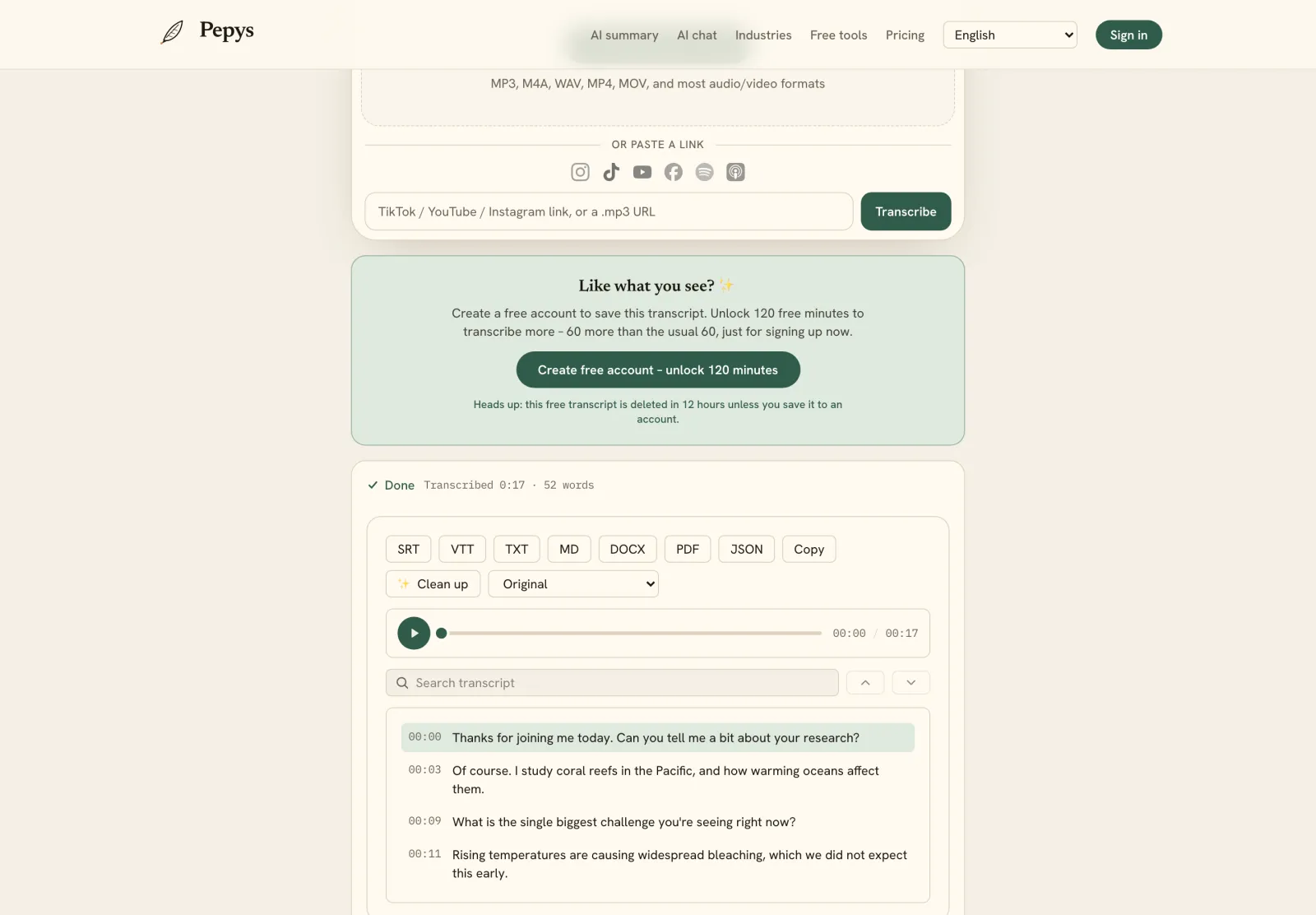
    Upload the recording to get a speaker-labeled, timestamped draft in minutes instead of up to six hours of manual typing per hour of audio.

  4. 04

    Verify against the audio and flag gaps

    Read the draft while listening. Fix names, citations, numbers, and crosstalk, and bracket anything unclear as inaudible with its timestamp rather than guessing.

  5. 05

    Route the official record; file the working copy

    For a filing-grade transcript, use a certified reporter or transcriber. Export your verified working copy to DOCX for the matter file, and delete sensitive source audio.

Tips from people who do this a lot

  • Treat the AI transcript as a working copy, never the certified record – only a credentialed reporter's certified transcript is official in federal court.

  • Spend your review time on the load-bearing 5%: names, dates, dollar figures, citations, and negations, where a single wrong word changes the meaning.

  • Keep timestamps intact so any quote in a brief or memo jumps straight back to the exact second of audio for verification.

  • For privileged or sensitive audio, pick a tool that doesn't train on your files and delete recordings after processing – confidentiality duties reach the transcript too.

  • Confirm consent on the recording itself before the substance starts, especially when a call crosses into an all-party-consent state.

Try it now

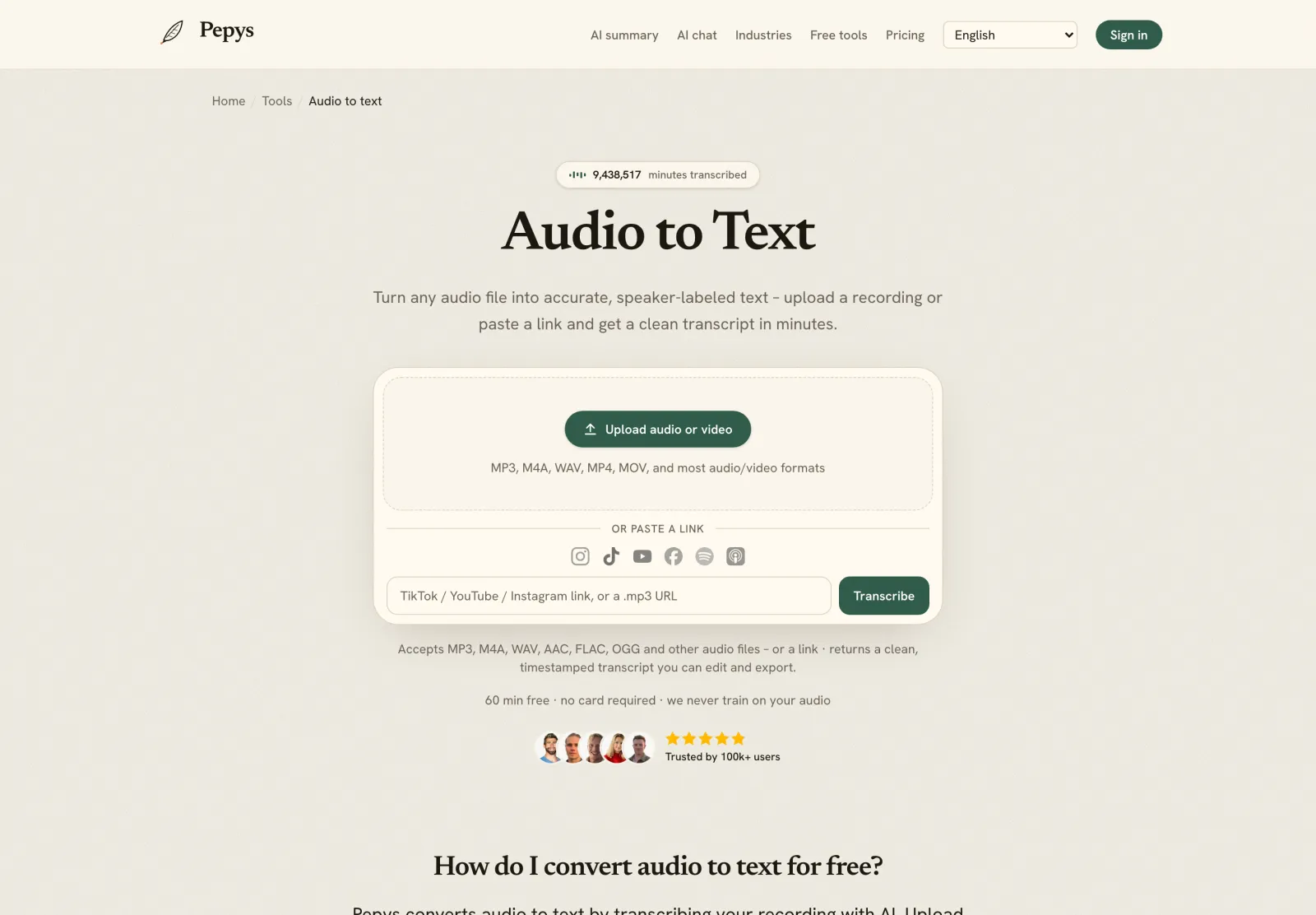
Drop in your recording or paste a link and get a clean, speaker-labeled transcript in minutes. Your first 60 minutes are free.

or paste a link
InstagramTikTokYouTubeFacebookSpotifyApple Podcasts

60 min free · no card required · we never train on your audio

PodcasterJournalistContent creatorResearcherStudent
Trusted by 100,000+ creators, podcasters, journalists & researchers

Legal transcription – questions, answered

Is an AI transcript admissible or official in court?

Not on its own. In federal court, 28 U.S.C. 753(b) makes only a reporter-certified transcript the official record, and the Judicial Conference format requires a certification on the last page. Use AI drafts for internal review and prep, then route the filing-grade record to a certified reporter or transcriber.

Do I need a certified court reporter for legal transcription?

For the official record, yes. Certification comes from a credentialed professional: NCRA's stenographic RPR, or AAERT's CER and CET for digital audio. Their skills tests require 95% accuracy to pass. AI can produce fast working copies, but it doesn't certify a transcript for filing.

Do I need one-party or all-party consent to record?

It depends on jurisdiction. Federal law allows one-party consent, and most states follow it, but about 11 states, including California, Florida, Illinois, and Washington, require all-party consent. Where a call crosses state lines, get everyone's agreement. We can't give legal advice; confirm your local rule first.

Should a legal transcript be strict verbatim?

Usually yes. Legal and evidentiary work generally wants strict verbatim, capturing every word, false start, and pause, because how something was said can matter. Certified reporters follow the prescribed federal format. Decide the style before editing and apply it consistently across the whole transcript.

Is my legal audio kept or used to train AI?

Not with Pepys. We never train AI on your audio or transcripts, and you can auto-delete files after they're processed. That matters under the confidentiality duty in ABA Model Rule 1.6, which requires reasonable efforts to prevent unauthorized disclosure or access to client information.

References

  1. 1.28 U.S.C. § 753(b) – official recording and certificationCornell Law School Legal Information Institute (LII)
  2. 2.Guide to Judiciary Policy, Vol. 6, Ch. 18 – Transcript Format (PART 18.1 & 18.17)Administrative Office of the U.S. Courts
  3. 3.About AAERT Certifications (CET / CER / CDR)American Association of Electronic Reporters and Transcribers (AAERT)
  4. 4.CET Practical Exam Passing Score Update (98% → 95%, eff. Mar 26 2026)American Association of Electronic Reporters and Transcribers (AAERT)
  5. 5.Registered Professional Reporter (RPR) – foundational certification and 95% accuracy requirementNational Court Reporters Association (NCRA)
  6. 6.Introduction to the Reporter's Recording Guide (state-by-state consent laws)Reporters Committee for Freedom of the Press (RCFP)
  7. 7.Rule 1.6: Confidentiality of Information (a) and (e) – verbatim adoption of ABA Model Rule 1.6Illinois Supreme Court (Reporter of Decisions)
  8. 8.Take the aTrain (Fleiss et al. 2024) – transcription time cost, citing Bell et al. (2018)arXiv / Journal of Behavioral and Experimental Finance

Keep reading

Don't just take our word for it.

Ask ChatGPT, Claude, or Perplexity what Pepys is and who it's for. One click, and your favorite AI does the homework.

Get your transcript – free to start

Pay as you go – credits never expire, nothing to cancel. Or start free with 60 minutes, no card.